ROJAVA INTERNATIONAL FESTIVAL OF CINEMA: CINEMA AS THE VOICE OF RESISTANCE AND SOLIDARITY
A Voice of Resistance and Support in Cinema
The festival is organised under the supervision of the Rojava Film Community.
The International Film Festival in Rojava is held in a region in the Middle East that has become a symbol of the struggle for freedom. This festival aims to bring together filmmakers, audiences, and artists from all corners of the world.
The festival does not regard cinema merely as a form of art; rather, it asserts that cinema is simultaneously a memory, a language of resistance, and a narrative of freedom.
The festival opens a space for the stories of oppressed peoples, women's stories, refugees' stories, and all oppressed identities.
With its revolutionary values and social structure based on the principles of people's brotherhood, pluralism, and an ecological life paradigm, democracy, and women's liberation, Rojava becomes an example for the world. Our festival also embraces these values, bringing to the big screen the voices that have been silenced, the faces that are unseen, and the memories that have been suppressed.
The dominant mentalities of capitalism and imperialism fuel conflict, discord, and destruction between peoples and cultures. In opposition to these mentalities, our festival highlights the togetherness and the libertarian and communal characteristics of cinema.
The Rojava International Film Festival continues to tell stories of peace, resistance, and freedom, using a language that crosses borders.
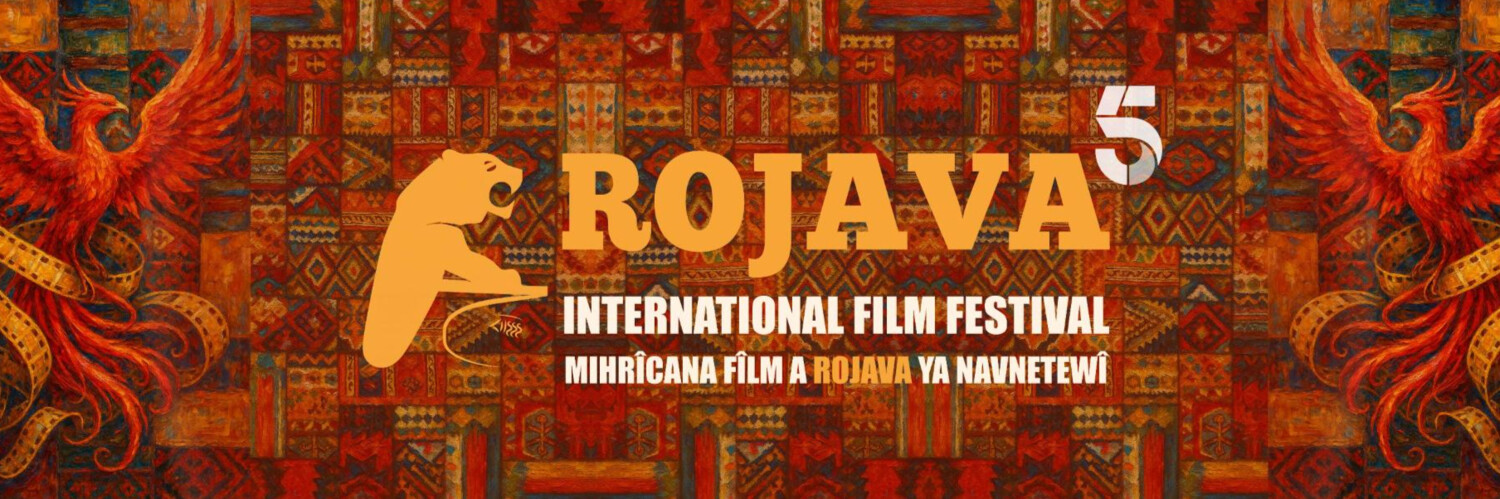
o FESTIVAL LOGO: (THE HISTORIC LION OF URKESH)
THE LION OF URKESH: an ancient bronze statue, symbolising power in the ancient Hittite kingdom of Urkesch (the Hill Mozan in north-eastern Syria).
Its history dates back to 3000 BC. This statue was found in the 'Lion Temple', and is a symbol of the Hurrian (Kumarbian) god. depicting desert life and indicating the development of bronze sculpture in the civilisation of Northern
o FESTIVAL AWARD STATUE: (SIMURG BIRD)
It is a symbol of resistance, endurance, and life: In Kurdish folklore, the Simurgh is a powerful symbol of renewal, immortality, and resistance, linking ancient legends with Kurdish literature.
The Simurgh is a powerful mythological bird that is reborn from its own ashes, representing willpower and immortality. It is often depicted in Kurdish poetry as a symbol of rising from pain and crisis, and of preserving cultural and national identity.
o FESTIVAL SLOGAN: (shared stories, free cinema)
“Shared Stories” signifies that different peoples and individuals can bring their experiences together and transform them into a greater narrative. We believe that these shared stories will foster the creation of a shared memory and shared values, and that in the face of social divisions, they will promote social and artistic solidarity. For us, every film is a piece of collective memory, and every filmmaker is a writer of this memory.
“Free Cinema” also indicates that this story should be presented in a clear, impartial, and creative way. This can be realised in its clearest and most powerful form in a free society. For this reason, free cinema is, at the same time, the language of the search for, and endeavour toward, a free society.
o DATE OF EXHIBITION: (ANNIVERSARY OF THE AMÙD CINEMA FIRE)
The festival is held annually on the 13th to 20th of November, on the anniversary of the Amud cinema fire of 1960, in which many children lost their lives.
Best Feature film
Best International Short film
Best Kurdish Short Film
Best Documentary Film
Best Short Screenplay Award
Best Feature Screenplay Award
Free Cinema Award
Free Woman Award
Democracy and Human Rights Award
The Effort Award
Special Festival Award
Jury Honourable Mention