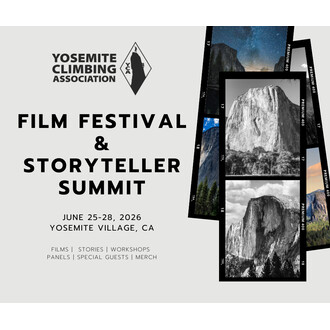

The Yosemite Film Festival & Storyteller Summit is a new annual event presented by the Yosemite Climbing Association, taking place June 25–28, 2026 in Yosemite Valley.

Rooted in one of the most influential landscapes in climbing and outdoor history, the festival celebrates films and stories that explore our relationship with wild places. Programming centers on climbing, outdoor adventure, environmental storytelling, and human powered experiences, with an emphasis on ethics, stewardship, and sense of place.

For more than two decades, YCA has hosted Yosemite Facelift, a nationally recognized stewardship event that brings thousands of volunteers to Yosemite National Park each fall. The Film Festival builds on that legacy by creating a dedicated space for storytelling, reflection, and dialogue through film.

Screenings will take place in established indoor venues in Yosemite Valley, with evening feature presentations and afternoon matinee blocks open to both festival pass holders and the general public. Select panel discussions and conversations with filmmakers and storytellers will complement the film programming.

This is an intentionally human scaled festival designed to serve filmmakers, climbers, park visitors, and outdoor communities who care deeply about the places they recreate in and the stories they tell about them.

Programming Overview

• Evening feature film screenings
• Afternoon matinee film blocks
• Panel discussions with filmmakers and storytellers
• Informal community gatherings for filmmakers, speakers, and pass holders

Programming takes place primarily indoors at approved venues in Yosemite Valley. Final schedules will be shared on our website as details are confirmed.

Awards will be presented:
BEST FILM
BEST CLIMBING FILM
STEWARDSHIP AWARD
GRANITE STANDARD
EMERGING FILMMAKER AWARD
FESTIVAL VOLUNTEER AWARD

No cash prizes are planned.

We are seeking films that explore climbing, outdoor adventure, and human powered experiences through a strong sense of place, responsibility, and respect for public lands.

As the birthplace of modern climbing culture, Yosemite has shaped not only how people climb, but how they tell stories about climbing. We welcome both historical and contemporary films that engage with this legacy and reflect evolving ethics, voices, and relationships with the land.

Selected films should demonstrate care in how landscapes, communities, and recreation are portrayed, and reflect thoughtful, ethical approaches to storytelling in wild and protected places.

Accepted Film Categories & Descriptions:

• Climbing: Past, Present & Future
Films centered on rock climbing, bouldering, alpinism, and climbing culture across generations. Submissions may explore Yosemite’s climbing history, influential figures and moments, or contemporary climbing stories shaped by the standards, ethics, and innovations that emerged from Yosemite.

Historical films, archival projects, and modern reinterpretations are welcome alongside present day narratives.

• Outdoor & Adventure
Human powered adventure stories rooted in wild places, including climbing, mountaineering, hiking, skiing, running, and other backcountry pursuits. We prioritize films that value experience, decision making, and relationship to place over spectacle or conquest.

• Stewardship & Ethics in Action
Films that engage with environmental responsibility, access, preservation, and land stewardship, particularly within public lands. Stories may be explicit or woven into the narrative, but should reflect an ethic of care, accountability, and long term thinking.

• Human Stories Shaped by Place
Character driven stories where landscapes like Yosemite are not just backdrops, but active forces that shape identity, community, culture, and responsibility. These films acknowledge both the inspiration and the impact of human presence on the land.

A Note on Responsible Storytelling

The Yosemite Film Festival & Storyteller Summit prioritizes responsible and ethical storytelling on public lands.

We encourage submissions that reflect honest representation, respect for land management guidelines, and awareness of how film and media influence behavior, perception, and stewardship.

Films that promote unsafe practices, misrepresent protected landscapes, or treat wild places as disposable settings for content may not be selected.