
A Journey Through International Cinema
A Celebration of the Seventh Art
Cinema As It Was Meant To Be Seen
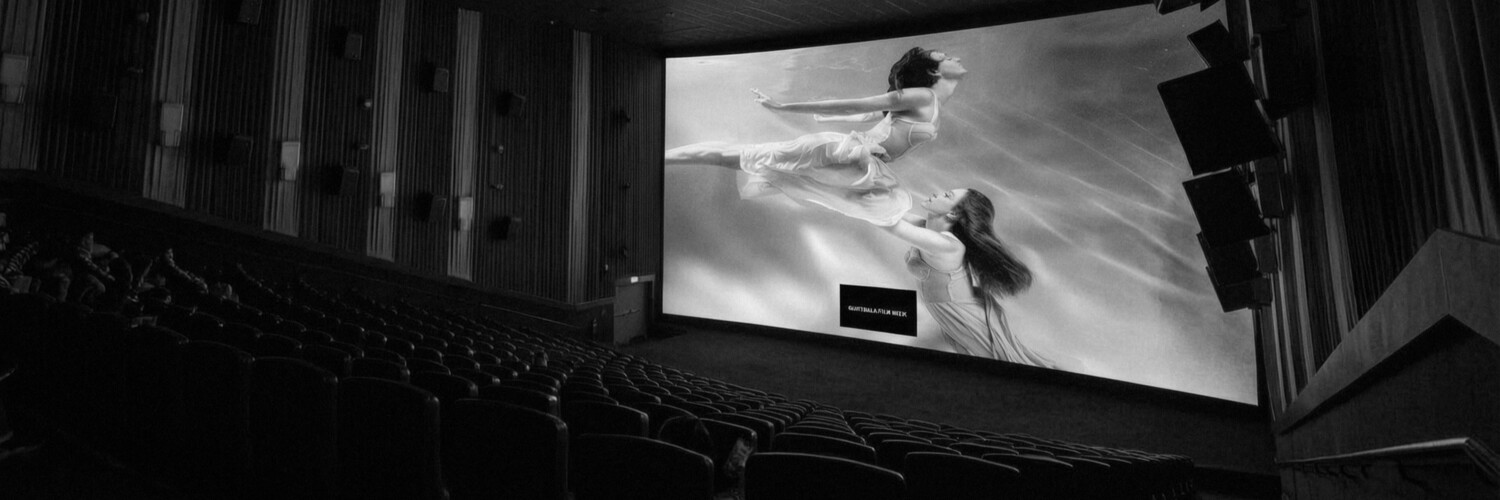
Guatemala Film Week is a celebration of cinema dedicated exclusively to the theatrical experience. Every selected film is screened in commercial movie theaters, reaffirming the big screen as the natural home of cinema.
At a time when most films are consumed across countless devices, Guatemala Film Week offers something increasingly rare: the opportunity to experience cinema as it was conceived. The scale of the image, the impact of theatrical sound, and the collective presence of an audience create a level of immersion that cannot be replicated elsewhere.
More than a festival, Guatemala Film Week is an invitation to return to the movie theater and rediscover the unique power of shared cinematic experiences. Its defining commitment is simple: every film, every screening, and every moment unfolds in the movie theater, where cinema has belonged since the very beginning of its history.
A Singular Editorial Vision
Guided by a unified curatorial direction, Guatemala Film Week presents a carefully selected program of international features, documentaries, short films, animation, immersive works, and emerging forms of audiovisual expression. The program privileges works distinguished by artistic ambition, formal rigor, and narrative strength, creating a concentrated forum for cinema as an art form.
Journalistic Authority at the Helm
The festival's recognitions are determined by a jury composed exclusively of established film journalists and critics from national and international publications. Their evaluations emphasize artistic achievement, cinematic language, cultural significance, and the lasting impact of a work beyond commercial considerations.
This critical approach reflects Guatemala Film Week's commitment to thoughtful evaluation grounded in editorial independence and a deep appreciation of cinema.
A Strategic Gateway for Films
Through sustained collaboration with critics, programmers, cultural institutions, and film professionals, Guatemala Film Week has developed a network designed to strengthen the visibility of selected works. This framework encourages meaningful dialogue, facilitates professional connections, and contributes to the continued circulation of films across the international cultural landscape.
Ideas That Transcend Budgets
Guatemala Film Week values conviction over scale. The week champions films that express original ideas, whether produced with substantial resources or through independent means. Submission is an invitation to have a film considered on the basis of its artistic merit, creative vision, and capacity to resonate across cultures and audiences.
Ceremony, Not Spectacle
Guatemala Film Week is not conceived as a marketplace for hype or an industry-driven race for premieres. It is a curated cinematic gathering dedicated to viewing, reflection, conversation, and discovery. Every screening, discussion, and recognition exists to foreground the art of filmmaking itself.
Guatemala as a Cinematic Host
To screen a film in Guatemala is to place it in conversation with a country rich in storytelling traditions, cultural diversity, and visual beauty. The host city becomes a meeting point where international cinema encounters local audiences, creating exchanges that enrich both filmmakers and viewers alike.
An Invitation
Filmmakers, critics, programmers, artists, and cinephiles are invited to participate in a week devoted to the screen, the story, and serious cinematic engagement.
Guatemala Film Week is a gathering for those who believe that cinema remains one of the most powerful artistic languages of our time.
THE LLORONA AWARD
The Llorona Award is the highest distinction presented by Guatemala Film Week, the award is 100% inspired by the roots of the myth of La Llorona, whose origin can be traced to pre-Hispanic Mexica tradition in what is now Mexico. One of its earliest references appears in the Nahua accounts compiled in the Códice Florentino by Bernardino de Sahagún, where a woman is described as a death figure walking through the streets of Tenochtitlan, her lament interpreted as an omen of transformation and the collapse of an era.
Named after one of the most enduring figures in the cultural imagination of Mesoamerica and Latin America, the award reinterprets La Llorona not as a folkloric ghost story, but as a cinematic archetype of memory, resonance, and narrative endurance.
Long before the arrival of Hernán Cortés and the Spanish conquest of Mexico, Indigenous traditions throughout Mesoamerica preserved stories of female spiritual figures associated with motherhood, mourning, destiny, and the relationship between the living and the dead. Among the most significant was Cihuacóatl, a powerful maternal deity connected to birth, protection, sacrifice, and the fate of communities. In the earliest colonial records documenting Indigenous traditions, a mysterious woman is described wandering through the night lamenting for her children, a figure later remembered as one of the prophetic signs preceding the fall of Tenochtitlan. This account, known today as the Sixth Omen or Sixth Presage, did not create the figure; rather, it preserved a much older symbolic tradition already embedded within Indigenous memory.
Across centuries, this ancestral presence evolved through encounters between Indigenous cosmologies, colonial history, oral storytelling, religion, literature, and popular culture. The figure became known as La Llorona, yet beneath its many regional variations remained a common idea: a voice that returns because what it carries cannot be forgotten.
For Guatemala Film Week, this is the meaning that gives the award its name.
La Llorona represents a voice that cannot be silenced. She is not merely a character, but a symbol of memory's persistence. Her cry survives because it expresses experiences that communities continue to carry across generations: loss, longing, grief, displacement, injustice, love, remembrance, and the search for meaning. She reappears not because she belongs to the past, but because the past continues to speak through the present.
Each retelling has expanded, challenged, and renewed the meaning of the legend while preserving its essential function: to give voice to what endures. Such interpretations demonstrate that La Llorona is not a fixed story, but a living cultural symbol whose significance continues to evolve across generations. Her permanence lies not in remaining unchanged, but in her capacity to be rediscovered and reimagined by each era. In this sense, La Llorona embodies the very quality that Guatemala Film Week seeks to recognize in cinema itself: the power of a story to transcend its original moment, remain relevant across time, and continue resonating through new audiences, new perspectives, and new acts of interpretation.
Cinema shares this same quality.
The most significant films do not end when the screening concludes. They remain alive within audiences. They return through memory, conversation, interpretation, and emotional reflection. Their images, ideas, and questions continue to resonate long after the final frame. Like the enduring figure of La Llorona, they resist disappearance. They become part of a collective experience that transcends the moment of exhibition.
The Llorona Award therefore honors the film that most powerfully embodies this enduring cinematic capacity. It recognizes artistic excellence, cinematic vision, emotional depth, cultural significance, and the ability to create a lasting connection between a work and its audience. The distinction celebrates films that not only demonstrate exceptional achievement in craft and storytelling, but that continue to speak beyond their immediate presentation.
During the Guatemala Film Week Awards Ceremony, audience members in attendance are invited to participate in a public vote for the film they believe most deserves the festival’s highest distinction. This participation reflects a fundamental principle of the award: stories achieve lasting significance through the communities that receive, interpret, and carry them forward.
The results of this audience participation are reviewed alongside the evaluations and deliberations of the Critics Jury. The President of the Critics Jury retains the final deciding vote and formally selects the recipient of The Llorona Award.
This structure preserves the festival’s commitment to critical rigor while recognizing the essential role audiences play in the life of cinema. The award thus represents a dialogue between artistic authorship, critical reflection, and collective interpretation.
More than a prize, The Llorona Award affirms cinema's unique ability to preserve voices across time. It celebrates films that continue to resonate after the screen goes dark, works that remain present in memory, and stories whose emotional, artistic, and cultural significance cannot be silenced.
In this sense, La Llorona is not invoked as a figure of fear, but as a symbol of narrative permanence: a story continually reimagined across generations, whose voice endures because it is carried forward by those who choose to remember. The Llorona Award celebrates cinema's highest achievement, the ability to become part of that living memory.
For more information visit: http://www.TheLloronaAward.com
Critics' Recognitions
The Critics Jury may also present honorary recognitions in the following categories:
Best Feature Film
Best Documentary
Best Director
Best Screenplay
Best Cinematography
Best Actor
Best Actress
Best First Feature
Best Short Film
Best Animated Feature
Best Animated Short Film
Best Fantasy Feature
Best Fantasy Short Film
Best Science Fiction Short Film
Best Videoclip
Best 360 VR Experience
Best Artificial Intelligence Short Film
Special Mentions
The Critics Jury and Programming Committee may grant Special Mentions to films that demonstrate exceptional artistic risk, innovation, cultural relevance, or unique creative achievement beyond established categories.
Purpose and Impact
The recognitions granted by Guatemala Film Week reinforce the festival's commitment to thoughtful criticism, artistic excellence, and public engagement.
These distinctions seek to amplify critical visibility, support the continued circulation of selected works, and celebrate films that contribute meaningfully to the evolving language of cinema.
