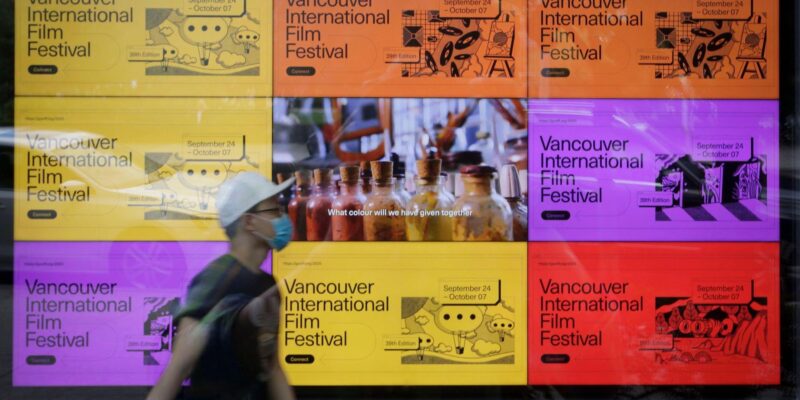
The 2025 Vancouver International Film Festival, running Oct. 2–12, looks destined to be its biggest year yet.
But while screenings of Richard Linklater’s “Nouvelle Vague,” Luca Guadagnino’s “After the Hunt,” Noah Baumbach’s “Jay Kelly,” and Rian Johnson’s “Wake Up Dead Man: A Knives Out Mystery” will be jam-packed with eager cinephiles, for Curtis Woloschuk, VIFF’s director of programming, it’s the festival’s depth of cinematic offerings that makes it special.
“[Those] are all fine films, but I hope people use this opportunity to dive into the festival. We have a remarkably deep lineup this year, with fantastic and intriguing films from Latin America, a deep focus on India, and a spotlight in South Korea,” he says.
Overall, around 260 films—170 features and 90 shorts—will screen across the city, and there will be filmmaker Q&As, talks, and workshops for festivalgoers to enjoy. No wonder MovieMaker named VIFF as one of 50 film festivals worth the entry fee.
Rivaling TIFF
VIFF has grown dramatically over the last 44 years. After initially running between 1958 and 1969, the current incarnation of the festival relaunched in 1982. “It was actually held at the beloved Ridge Theatre, but we only had a small scale of films,” says Woloschuk. In the years since, the event has expanded to celebrate a variety of films from across the world, has a robust documentary program (with around 45 screenings this year), and showcases local filmmakers and Canadian cinema.
“We are neck and neck with the Toronto International Film Festival in terms of having the largest Canadian program for feature films,” explains Woloschuk, who has been with the festival since 2013 and was made director of programming in 2022. “We also aim to play award-winning films from Cannes and Berlin. We have films from over 70 different countries.”
International connection
The festival’s dedication to aiding the careers of burgeoning filmmakers is best exemplified by its Vanguard section, which is saved for first- and second-time narrative features from international directors. “We want to establish opportunities and competitions for international filmmakers,” Woloschuk says.
VIFF looks for filmmakers from across the world to come to the festival, so they can promote and discuss their work, and hopefully build long-lasting connections with future collaborators. VIFF even provides complimentary accreditation to international filmmakers, as well offering deals for flights and hotels. To achieve this, they have built relationships with film agencies in France, Switzerland, Taiwan, and other international movie organizations and consulates. “We are always looking to increase the bandwidth we have for resources to get filmmakers to the city,” adds Woloschuk.
The Romanian consulate in Vancouver will host a cocktail reception for the festival, where there will be a variety of networking opportunities. “We want to develop co-production opportunities and use Vancouver’s geographical position and our history of programming international cinema, especially in East Asia, to engage with those regions,” Woloschuk says.
What VIFF is looking for
Programmers want to see new perspectives, a level of expertise, and a lived experience in the films that are submitted, he explains. Screening committees, which consist of a couple dozen filmmakers and educators, spend all year watching the tens of thousands of shorts and features that are sent in. Woloschuk advises filmmakers who are considering entering their work to VIFF to make sure the festival has screened comparable films before.
In addition to having a vast shorts program—there are usually between 80 and 90 short films each year—the fest’s Spectrum section looks to spotlight films that are a hybrid of documentary and nonfiction, essay films, and experimental. “We see the shorts as a mechanism for spotting talent early,” says Woloschuk. “We want to find the people that are going to be making pictures down the road, all while honoring the fact that shorts are their own pieces of work.”
In the past, the fest has been champions of early career filmmakers: Sophy Romvari first premiered her 2017 short “Pumpkin Movie” at VIFF, before her full-length debut “Blue Heron” bowed at TIFF last month to rave reviews.
The festival has screened Sophie Jarvis’ short films (“The Worst Day Ever,” “Penny’s For Tea”) that preceded her 2022 debut feature “Until Branches Bend,” which also premiered at TIFF. And VIFF has premiered numerous films by documentarian Kathleen Jayme (“Finding Big Country,” “The Grizzlie Truth”).
Why filmmakers should attend
VIFF has always prided itself on providing strong experiences for filmmakers on the ground. There will be at least five networking events for filmmakers to attend so they can grow their connections; and the festival also hosts dinners, and will sometimes even introduce collaborators if they seem like good creative fits.
There are over 20 artist and industry programs this year, including talks with directors Janicza Bravo (“Zola”) and Andrew DeYoung (“Friendship”), screenwriter Jenny Lumet (“Rachel Getting Married”), showrunner Brian McGinn (“Chef’s Table”), and cinematographer Frederick Elmes (“Blue Velvet,” “Synecdoche, New York”); and master classes on potential Canadian co-productions with South Korea, the power of postproduction, and how to build an international audience.
Since Vancouver is home to its own vast film industry, with thousands of professionals who have repeatedly worked on Hollywood blockbusters, as well as numerous film schools, Woloschuk is constantly impressed by the insight and knowledge from its on-average 84,000 attendees. “Plus, Vancouver is a really good city to go and explore, including the areas outside of the city,” he boasts. “We’ve had groups of filmmakers go on a hike together at the San Juan Valley. We want to give people the opportunity to engage with the natural beauty of the area.”
But while Woloschuk is delighted with the size that the festival has grown to, he admits they have no plans to expand it even further. Instead, their focus is on deepening the experiences for filmmakers. “The next few years are about how we build out our artists and industry programs. We want to create more sales and development opportunities for regional filmmakers, as well as those who attend from across the world.”