As Nora Garrett tells us, her dad calls her an “overnight success…10 years in the making.”
After studying acting at New York University Tisch School of the Arts, the “After the Hunt” screenwriter did a little bit of everything in Los Angeles, working as a personal trainer, personal assistant, and actor. But her life changed forever once she sat down and penned a story about a Yale University professor confronting her past when a trusted colleague is accused of misconduct. What Garrett thought would be a spec script that might land her representation turned out to be something much bigger.
The material soon became a hot package within the industry. Producer Allan Mandelbaum (“Fair Play,” “Ingrid Goes West”) advocated for the project with Imagine Entertainment and CAA, which in turn helped land Oscar-nominated director Luca Guadagnino and a star-studded cast that includes Julia Roberts, Andrew Garfield, Ayo Edebiri, and Michael Stuhlbarg. Suddenly, Garrett found herself premiering her debut film at the Venice Film Festival.
“I banged my head against a wall for so many years,” Garrett says of finally breaking through. “I do think there’s a certain amount of people who hear my story and they are either very inspired—‘It can happen’—or incredibly annoyed. [Laughs] And, honestly, I understand both sides. I feel so incredibly lucky, and it’s one of those wonderful surprises where sometimes what you think you want for yourself is actually not the right place for you to be, but this just feels like the right time and place.”
Here, Garrett shares the lessons she’s learned and the advice she’d give to aspiring writers.
When you reflect back on this life-changing experience, where does your mind go first?
It’s been such a whirlwind. In my wildest dreams I never could have predicted this trajectory for my script. Looking back to the past version of myself, she has no idea what’s about to happen. At the time of writing it, I thought: Best-case scenario, I’ll use this as a spec script to get a manager. It’s obviously a difficult subject matter—a very talky script with a lot of intellectualism in it—so it’s not anything that anybody ever tells you to write, especially as someone who didn’t have a full-length screenplay to their name.
So where did the idea of “After the Hunt” come from?
The genesis began with the character of Alma Imhoff [Roberts]. I was really interested in people who have power and wield power, as well as the emotional cost of power and success. What if there’s this woman who has this secret, and encased around that secret is a lot of shame? And what happens if she really presses that down in order to become the person that she becomes? And does that compartmentalization actively fuel the desire to be so outwardly successful because inwardly she can’t fully accept herself? And then what happens if there comes a point where that self-denial is deeply challenged?
This being your first script, what was the writing process like?
Looking back, I think it was a crystallization of themes that I’ve been gestating on for a really long time—because I had tried to explicate power dynamics and complicated female relationships in different forms, and this was sort of all of that in potentially the right type of container.
But I was actually writing the first draft when I was taking a class taught by [screenwriter] Tim Neenan, whose focus was structure and just getting through a draft. His philosophy is that getting the first draft done is the hardest part, and then once you have that, you can shape and mold. And I think that changed everything for me. It really got me out of my own head and let me follow the first impulse to the end of that impulse, even if I ended up changing it on the back end.
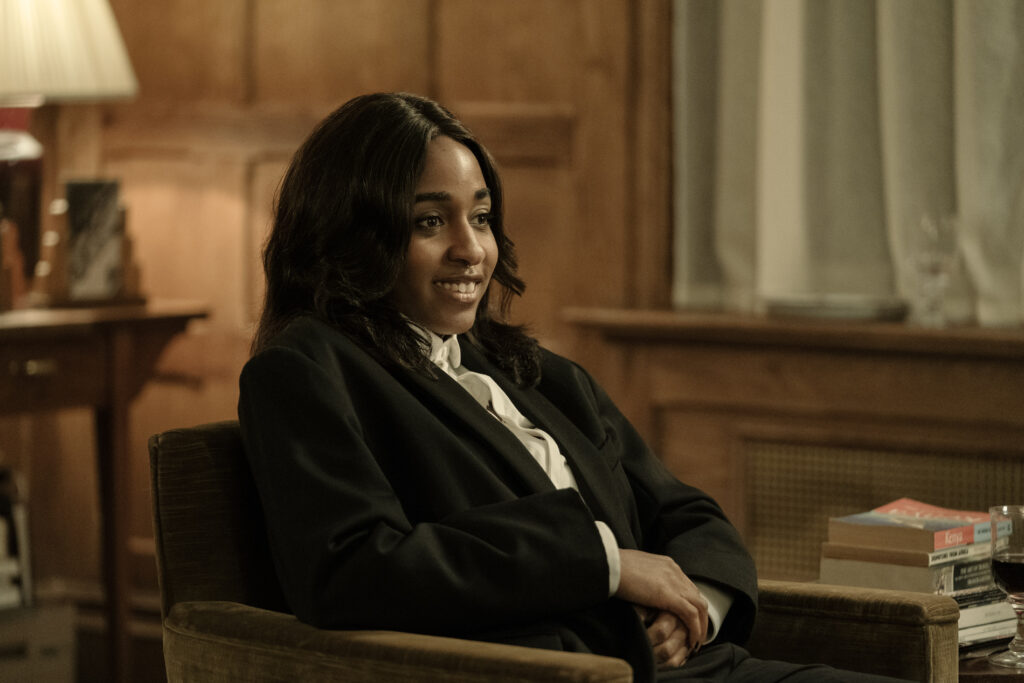
Having written this script on your own, what was the experience like when Luca came into the mix?
Luca coming on was something that I thought was never going to happen. When Imagine Entertainment got involved, Luca was at the very top of the list for directors, and I thought maybe we’d get into his inbox and that would be it—and I would have considered that a victory. But when his schedule opened up and he was interested, our first meeting was at Chateau Marmont in Hollywood, where I used to work as a hostess. So my old manager was standing a couple feet away from me having this meeting with Luca Guadagnino. He was like, “Why is the girl who used to play crossword puzzles at 1:00 a.m. at the host stand here?” [Laughs]
So that was a very surreal, out-of-body experience. I was constantly expecting this to fall apart, because I was trying not to get ahead of myself. But Luca has so much confidence, and he moves so swiftly and knows exactly what he wants. And that’s such a gift as a writer to have someone who gives you very specific notes that come from his deep understanding of cinema and the language of cinema. I felt so lucky that he wanted to bring all of that to bear on this.
With Luca and this cast, you’ve really set the bar high out of the gate.
I was telling one of my friends: Is this the equivalent of peaking in high school? Like, what am I gonna do next?
Speaking of, what lessons did you learn on “After the Hunt” that you’ll carry onto the next project?
Because Luca moved so quickly, and we had rehearsals and rewrites, I learned how to write under pressure and to trust the fact that I knew what I had created. Also, Julia Roberts was instrumental in showing me where things could get cut. I wrote these really long monologues, and you don’t need that much text when you have someone as good as her. So she really taught me the autonomy of words.
What advice would you give someone who is looking to break through like you did?
For a long time, I had a very pedantic notion of what being an artist meant. I had this fantasy that I’m going to wake up at 5:00 a.m. every morning, write for two hours, and then I’ll go to work. And that just never worked for me. My friend told me that sometimes you have to lower the bar low enough so that you can get over it.
So if you can write 10 minutes a day, write 10 minutes a day, and you’ll probably end up writing for two hours. But if you tell yourself you’re going to write for two hours and then you only write 15 minutes because life gets in the way, you’re gonna feel like crap about yourself. Then that makes it much harder to pick it up the next day. I need the bite-size structure of small, measurable goals; otherwise the task just feels way too daunting. And don’t let “great” be the enemy of “good,” especially when it comes to first drafts. Get it out, and then it can become great through shaping.
This interview has been edited for clarity and length.