Sometimes style can weigh more than substance. Of course, it’s necessary to have both for a great film, as seen in this year’s critical darlings: Ryan Coogler’s horror drama “Sinners” and Paul Thomas Anderson’s political epic “One Battle After Another.” But what made those films stand out were the distinct visions and instantly recognizable stamps of their directors.
Here, we take a look at five auteurs who have released a film in 2025 and their hallmark techniques that make them who they are. While these filmmakers may not have invented their visual languages, they have successfully popularized, innovated, and made them their own.
Paul Thomas Anderson’s kinetic camera movement
Anderson, also known by his initials PTA, has been touted as one of the most prolific directors for nearly 30 years. His films are known for their flawed and vulnerable characters, such as Daniel Planview (Daniel Day-Lewis) in “There Will Be Blood” (2007) and Barry Egan (Adam Sandler) in “Punch-Drunk Love” (2002), as well as for his dynamic camerawork. Across his 10 feature films, Anderson keeps the camera moving through a series of long takes, pans, and precise push-ins.
Whether it’s a 360-degree pan of a small bedroom in 1997’s “Boogie Nights,” or an intense rollercoaster-esque POV shot of a car racing through rolling hills in “One Battle After Another,” PTA’s projects are all filmed with a kinetic energy that keeps your eyes hooked on the screen at all times.
The opening of “Boogie Nights,” his second feature, begins with a sweeping steadicam sequence that takes viewers inside a nightclub and across the dance floor, while introducing several of the film’s key characters. In the first five minutes, we’re already immersed in the fast-paced lifestyle that the main character, Eddie Adams (Mark Wahlberg), eventually falls into. This scene was shot in the early years of Anderson’s career, yet it feels as if it was directed by a creator with extensive experience due to its bold camera choices.
“My instinct is to say that I’ve gotten more confident, but anyone who’s done this knows that confidence is an illusion,” he said in a 2021 interview with Variety. “You may have 25 years of practice, but when you walk on that film set, you’re right back to being a fucking novice again. That’s the pull or the addiction for many of us who do this thing.”
Wes Anderson’s symmetrical filmmaking
It takes just one frame to tell that a film was directed by Wes Anderson. While he’s known for imbuing his movies with colorful palettes and characters delivering quirky dialogue in deadpan tones, his most notable signature is the constant use of symmetry in his filmmaking.
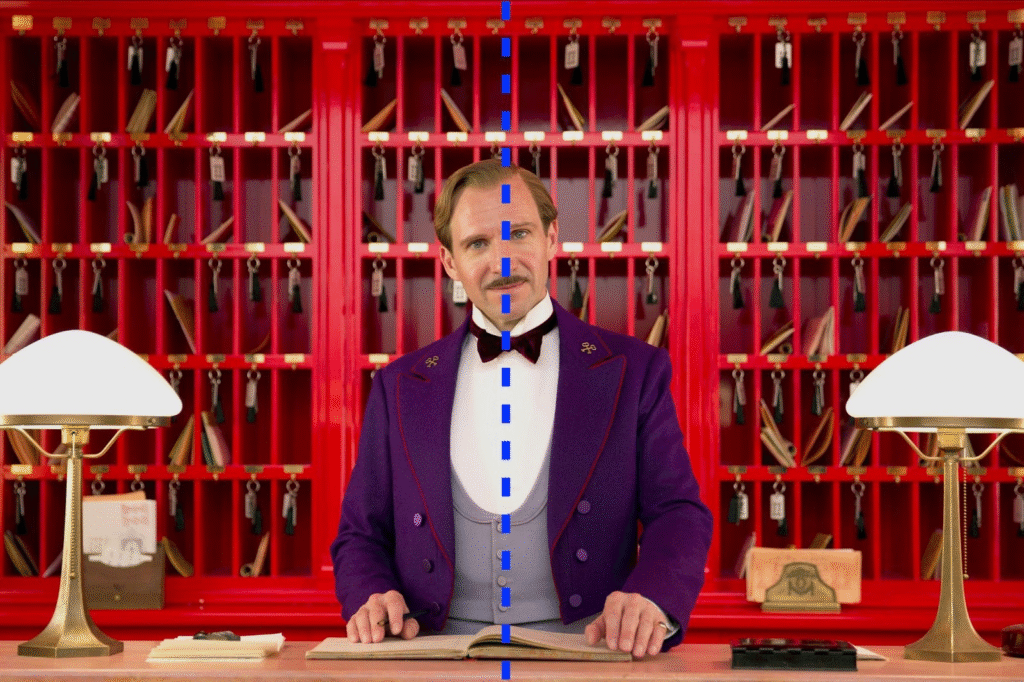
Consider this frame from 2014’s “The Grand Budapest Hotel.” Ralph Fiennes’ Monsieur Gustave H. is placed in the center, with the left and right side mirroring each other:
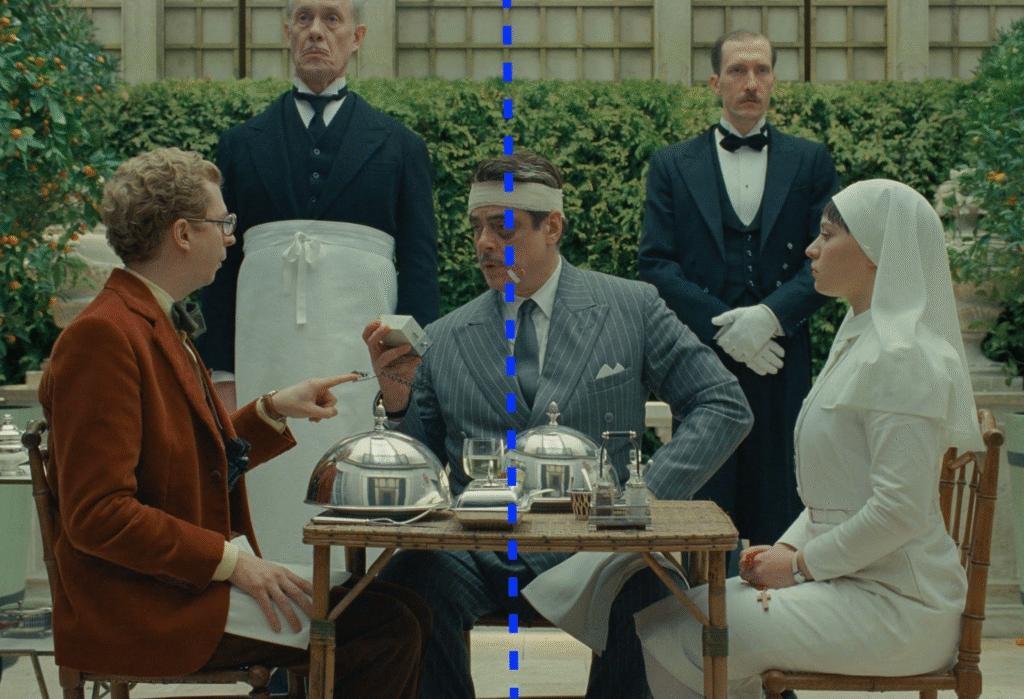
There’s also this example from his latest film, 2025’s “The Phoenician Scheme.” Zsa-Zsa Korda (Benicio Del Toro) is perfectly centered between Bjørn (Michael Cera) and Sister Liesl (Mia Threapleton), with two butlers on both sides of the frame:
There are plenty more symmetrical shots to find across his filmography, but Anderson takes it even further with symmetrical composition, editing, blocking, and staging. In scenes that feature two characters conversing, he uses symmetrical reverse shots where each character is framed straight on in perfect alignment.
“One thing I’ve learned over the years is how important it is when you’re making a scene to just have total clarity—how sometimes, visually, you can not know where to look and not know what’s important,” Anderson told Slant Magazine. “So I probably am overly clear in a lot of cases. And I often do things where we may not have a lot of cuts, for instance, and in a case like that you really need to get the necessary things in the shot at the right time and place.”
Ryan Coogler’s perfect one-shot
The incredible juke joint musical sequence in “Sinners” is nothing short of iconic. In the scene, Sammie Moore (Miles Canton) plays the blues and puts on a performance so transcendent that it conjures ancestor spirits from the past and future. The camera travels around the juke joint in a continuous take, highlighting the influence blues has played in various genres, including rock and hip-hop. It’s an unparalleled sequence that left many asking: How the hell did Coogler and his team pull that off?
The answer is with a lot of planning and rehearsals. The scene was first mapped out in a previz made by the VFX team and cinematographer Autumn Durald Arkapaw. Then, composer Ludwig Göransson worked with musician Raphael Saadiq to write music that would match the scene’s hallucinatory intensity. Choreographer Aakomon Jones worked closely with performers to ensure their dance moves changed to reflect each time period being represented. The whole sequence was filmed on 65mm Imax film, which meant it had to be broken into chunks to fit on the reels.
“We had to get up on that [soundstage] and rotate around, and really be definitive about when we introduce these ancestors and how they come in,” Coogler said in an explainer for the New York Times. “With this swirling feeling, we wanted to give the feeling of an incredible concert and being swept away and overwhelmed by the artistry.”
While this is the biggest and most complex use of the one-take Coogler has incorporated in his films, he’s also used the technique in “Creed” (2015), placing viewers inside the boxing ring for four minutes uninterrupted by visible cuts, as well as “Black Panther” (2018), which features an action sequence that has the camera travel through two floors of a chaotic casino brawl.
Spike Lee’s double dolly shot
It’s impossible to have a conversation about unique directors without bringing up Lee. You always know you’re watching “A Spike Lee Joint” based on its New York representation, socially charged themes, and his signature double dolly shot.
The double dolly is an innovation on the dolly shot created in 1907 by Spanish filmmaker Segundo de Chomón, in which a camera is mounted on a cart traveling on dolly tracks, and moves toward or away from the subject. The double dolly shot adds an actor on a second dolly across from the camera and moves both the camera and actor along the tracks at the same pace, creating a disorienting effect for the viewers: The subject appears still and the background moves past them.
Lee has used this technique in nearly all his films, including “Mo Better Blues” (1990), “BlacKkKlansman” (2018), and this year’s “Highest 2 Lowest.” However, “Malcolm X” (1992) arguably features his most iconic use of the double dolly shot. The camera centers on Malcolm’s (Denzel Washington) stoic face seemingly accepting his fate as he’s pulled through the neighborhood he’s about to be assassinated in—all to the tune of Sam Cooke’s “A Change Is Gonna Come.”
“I’ve done it several times; it’s almost become a signature shot,” he told GQ. “But [‘Malcom X’] is the best use of that we have. Many people told me that Malcolm knew he was gonna be assassinated on the way to the Audubon Ballroom, and I said, ‘How can I convey this?. Because he’s not gonna say it.’ I said: ‘Double dolly shot.’ ”
Chloé Zhao’s use of natural lighting
Zhao emerged as a promising new director at the 2015 Sundance Film Festival with her feature debut, “Songs My Brothers Taught Me.” She followed that up with “The Rider” (2017) and “Nomadland” (2020), which won best picture, best director, and best actress for Frances McDormand at the 93rd Academy Awards. The connective tissue through all these films is her ability to create a realistic atmosphere with natural lighting, a technique she even used in the big-budget Marvel blockbuster “Eternals” (2021).
According to Zhao’s long-time cinematography collaborator Joshua James Richards, they shot “Nomadland” with wide lenses at the magic hour to capture those expansive beautiful landscapes and help ground audiences in the story. “I wanted to be inside their world, and I didn’t want to be shooting from a distance with zoom lenses,” he explained to Variety. “The lenses were a little softer, and because we know we’re shooting in super low light conditions, that’s going to give me a little bit more leeway as that sun disappears further over the horizon.”
For Zhao, the process is all about patience. “From very early on, I made films so cheaply that we had nothing in our favor but the light in the sky and the freedom of time,” she said in an interview with American Cinematographer. “So if I can’t put on a huge production, I’m going to wait for those 20 minutes [until the light is perfect]! No matter how much money you have, it’s very hard to get that light right.” This is a mindset that she seems to stick with for her upcoming drama “Hamnet” (in limited theaters Nov. 27), which also features real documentary-esque lighting in its cinematography.