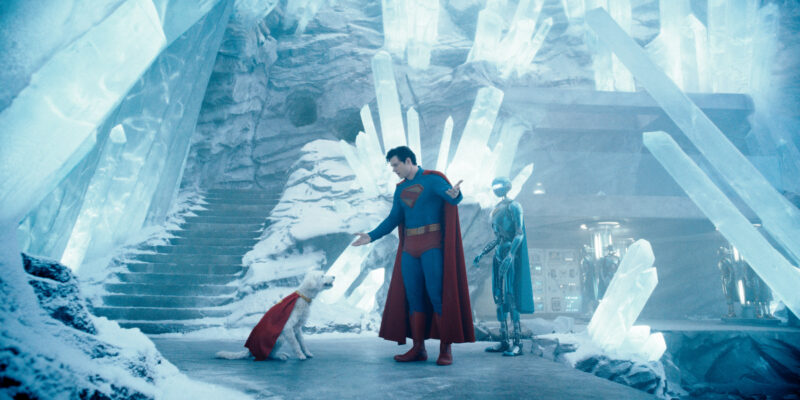
Prior to the release of James Gunn’s “Superman,” the prevailing sentiment in response to the film’s trailer was: Why does “Superman” look like that? Fans accustomed to the cleaner look of Richard Donner’s iconic, Christopher Reeve–led “Superman: The Movie” or the gloomy stylization of Zack Snyder’s “Batman v. Superman: Dawn of Justice” (or even the flat, low-contrast simplicity of most Marvel films) might have been thrown by two key elements used to make Gunn’s iteration.
The first is the use of short (or “wide”) lenses—for both freewheeling kinetic action and theatrical drama—which expand depth and exaggerate movement. This becomes especially noticeable when filming a character known to travel “faster than a speeding bullet.” The second aspect is the movie’s cool blue palette, which feels like an extension of Superman’s iconic garb.
Of course, marketing often elides context, and Gunn’s whizbang, kindness-as-punk-rock take on the Man of Steel proved a hit with audiences, despite the movie’s shortcomings. To understand the choices behind the film’s appearance (and to define what it even looks like, before addressing the why), we went straight to the source: director of photography Henry Braham. The film’s director and cinematographer have also worked together on “Guardians of the Galaxy Vol.2,” “Guardians of the Galaxy Vol. 3,” “The Guardians of the Galaxy Holiday Special,” and the DC ensemble film “The Suicide Squad.”
Like any artistic decisions, those made by Braham and Gunn were rooted in story. The film sees Superman, aka Clark Kent (David Corenswet), wrestling with simple ideas of hope and goodness in a complicated world—and on an enormous Imax scale—resulting in a tale that brings old-school nostalgia into conflict with the enormity of modern politics. To unlock how these forces intersect with the film’s aesthetics, we sat down with Braham to discuss what considerations went into designing this vision of the Man of Tomorrow.
You and James Gunn create larger-than-life, supernatural momentum through movement and short lenses. How did you figure out that feeling, in the flying scenes and otherwise?
It’s a choice about the relationship of the camera to what’s happening in the scene. James is interested in creating an immersive experience for the audience, so that means putting the camera in among the actors. The moment you do that, the camera becomes a conduit for the director’s voice.
Putting cameras close to actors is not new at all; in fact, it’s very old-fashioned. But being able to move dynamically with cameras close to [actors] has only been enabled because of the miniaturization of cameras. One of the things that has happened in the last five years is that we’ve managed to make an Imax camera the size of a Hasselblad. That is very significant, because that means that James can put the camera in close to the action, and then it can move very dynamically. Because we’re shooting on wider lenses, it means the camera can be very expressive and move very freely. I also think it enables the camera to connect with the performances and the actors in a much more direct way.

Do you find that the relationship between the camera and the characters evolve, depending on how an actor’s performance shapes a scene? Or is that something established entirely beforehand, without much wiggle room?
Well, “both” is the honest answer. James is very planned, articulate, and specific, because that’s the way he writes; the scene is set and defined dramatically. But if things evolve and change, and of course they always do, then the camera is connected to the actors and it’s infinitely flexible.
On the one hand, there’s very defined intent, structure, and articulation of how any scene or sequence is going to be shot. Within that—and it’s one of the reasons I shoot handheld—I can be totally intuitive at the same time. Which I know sounds contradictory, but that’s exactly what gives [the scene] its dynamism and energy.
While filming with large format cameras for Imax presentation, what do you keep in mind when shooting scenes grounded in emotional intimacy?
I’m interested in the smallest physicality. Because of shooting on a large format, we can shoot on wider lenses. If you think about some of the most spectacular films from the ’50s, ’60s, and ’70s, in the period of CinemaScope, that’s how those movies were shot: with wider lenses, closer to the action. What they couldn’t do was move as freely as we can now.
You might think of handheld as quite disturbing. It’s a very strong statement [that] of course has its place in storytelling. But by developing stabilization techniques that are bespoke to the way I work, we get the best of all worlds. We get the intuitive nature of being handheld without the audience being aware of the camera.
This story is about hope and humanity. Our traditional notions of those themes tend to be associated with warm colors, but “Superman” goes in the opposite direction. What were the considerations behind pushing cooler shades?
This is very specifically a colorful world with energetic light, but none of those things work unless you have a counterpoint. If you listen to a piece of music, it can’t all be loud. You have to have quiet bits. Color in itself doesn’t make a colorful movie. But I think, on a much bigger screen, you need to be more articulate. The camera needs to be articulate; photography needs to be more articulate. Obviously, color in set design and costume are critical…. At that point the director, in this case James, decides that’s the kind of visual voice and language of the film. Everybody understands how color will render, so that’s the first thing.
The second thing is: The overriding goal here is to be grounded and truthful; therefore, pushing warmth or warm colors early on is not helpful. Sunlight is eventually important. But if you try to impose something on the movie at first, it very quickly starts to look fake, and then it inevitably interferes with the story. Color is just like any act in storytelling. This may be a fantasy movie, but it still needs to be based in some reality that the audience can connect to.
This interview has been edited for length and clarity.