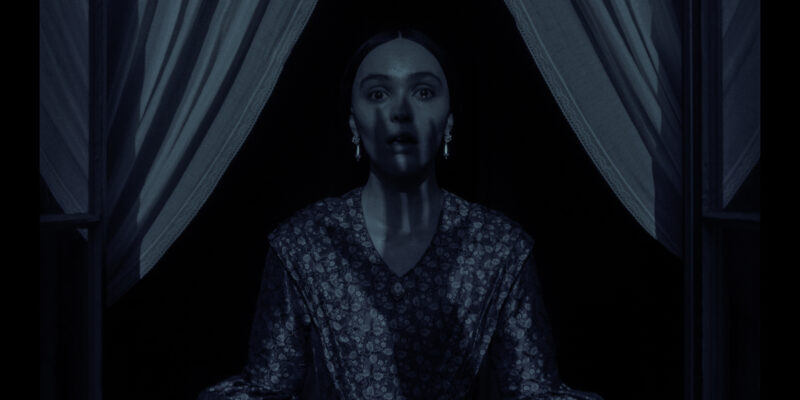
Director F.W. Murnau’s “Nosferatu: A Symphony of Horror,” now over a century old, began as an unauthorized adaptation of Bram Stoker’s 1897 classic novel “Dracula.” Several versions of Stoker’s gothic Count Dracula and Murnau’s eerie Count Orlok, originally played by Max Schreck, have followed. Yet Robert Eggers’ 2024 remake (in theaters Dec. 25) still manages to break new ground.
The basic outline follows Murnau’s 1922 silent film: Real estate agent Thomas Hutter (Nicholas Hoult) travels from Germany to the Transylvanian estate of the shadowy Count Orlok (Bill Skarsgård). Orlok is infatuated with Hutter’s wife, Ellen (Lily-Rose Depp), and moves to their hometown of Wisborg to seduce the young bride. However, between Orlok’s appearance—which has been mostly hidden from the movie’s marketing—and Ellen’s more sexually charged tale of possession that aligns more closely with Stoker’s text, Eggers’ conception of these characters and their world is radically different from any previous iteration.
We sat down with Eggers to discuss some of the approaches and techniques that went into creating a version of this well-worn story that still finds ways to stand apart, beginning with its seductive allure.
“Nosferatu” has a feeling of constant climax, where the audience is being pulled deeper into the story. What considerations went into shooting and editing for this effect?
Robert Eggers: It’s a combination of several things. What happens in each scene seems to get a little worse. That helps keep things moving. Every scene ends badly, with a new problem. The other thing is, visually, [cinematographer Jarin Blaschke] and I use these long, unbroken takes that are also generally center framed; so you have this camera that acts like a tractor beam to some degree, pulling you through the film and through the story.
How did the music and sound design contribute to this feeling of luring us into each scene?
RE: Some of it is aggressive, standard horror movie music, but other times, there are more subliminal things: [Composer] Robin Carolan invented this melty sound that swirls and kind of makes you sick to your stomach. Sometimes we mix it very low. You might not even know that it’s there, but it’s contributing to the feeling of tension and unease. Oftentimes if there’s a scene without score, [sound designer Damian Volpe and I] looked at it and thought: OK, this story beat should be accompanied by a subliminal thunder roar, or a little gust of wind, or something to help the story move forward.
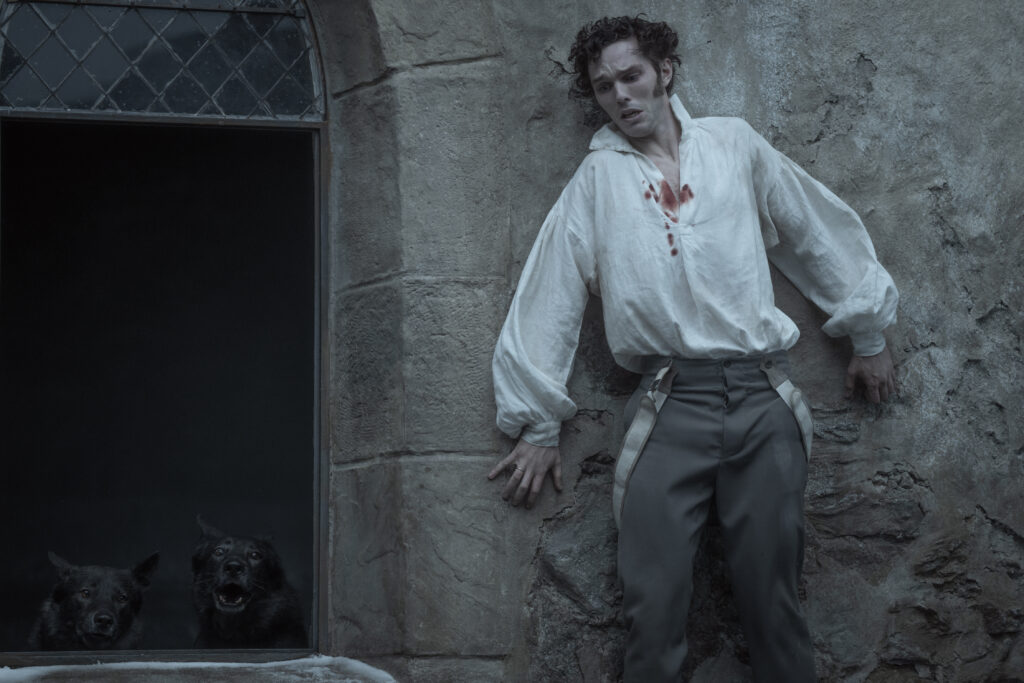
Orlok’s castle is a disorienting space, but we’re always tethered to Thomas’ perspective. How did you balance the character being lost while still giving us a sense of where he’s headed?
RE: We wanted it to feel like [Thomas’] nightmare. So, thinking about how you would experience a nightmare, we often do weird things like cutting to have him enter shots the wrong way—as far as what traditional editing patterns say you should do. We’re also hiding cuts within pans to change the geometry and the geography of the castle, so we can repeat locations—but you don’t even know that they’re being repeated because we’re shooting them backwards or omitting a large section, but it still feels like one shot.
In the reveal of Orlok himself, you use a lot of shadow and flame—or what appears to be flame. What was your process for gradually bringing the character’s appearance to light?
RE: Unlike other cinema versions, or even the novel “Dracula” where he’s at least human-appearing, [our version of Orlok] is a corpse. He doesn’t want his houseguest to know that he’s a corpse, so he’s trying to keep his distance and stay in the shadows. We did shoot all the Transylvania stuff with flame. There’s the candles onscreen that are helping with exposure, but then, out of camera, there are usually a lot of tea candles adding a little extra boost, or a gas flame adding some fill light.
But even more than that, Jarin used a lot of mirrors to reflect the candlelight, to give it more exposure. We also designed the makeup to help this—where the brows, cheekbones, nose, and the tip of the chin are the least degraded and rotting parts of him, so that when you get the light just on [Skarsgård’s] highlights, he can look more human. But then as he recedes, he gets more disgusting and nasty.
Lily-Rose Depp is firing on all cylinders, with work that’s raw and unhinged, but at the same time, she’s constantly vulnerable. What was the process of capturing a performance that oscillates between these rhythms?
RE: With the way Jarin and I work, the actors have to fold into the rhythm of the camera, which is kind of backward. But when we’re designing shots, the idea is to tell the story and to support the emotion of the character. Lily-Rose is a phenomenally brave and incredibly hardworking performer, and I think so much is appropriately being applauded about the physical stuff she’s doing. She worked tirelessly with Marie-Gabrielle Rotie, the [movement] choreographer, on doing all the body work, which is both physically and emotionally exhausting—because she’s not just moving around; she’s being possessed or being tormented.
But she also gives these two very long monologues. One of them is describing a dream, and one of them is describing a memory. Those kinds of monologues are really hard to do, and to keep engaging. And the level of subtle detail that she’s able to give in order to bring us in is really exciting. It’s just so easy for the camera to enjoy her face during that performance, because she lets herself open up to the camera.