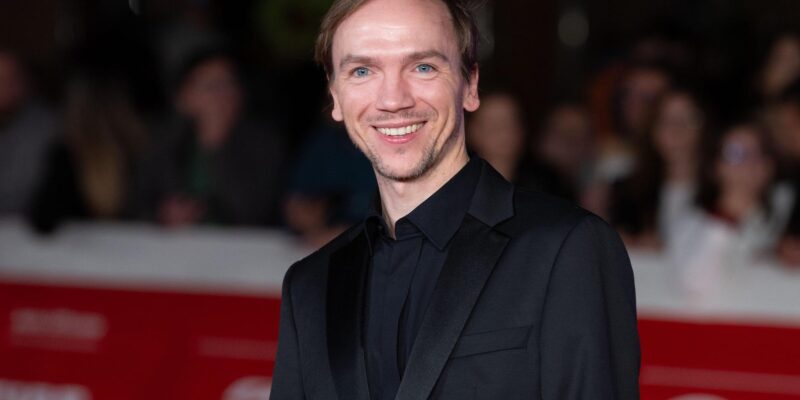
Jan Komasa’s “Anniversary” unfolds in what he calls a “nightmare scenario” of parasitic ideological invasion. The film, out Oct. 29, tracks one family, the Taylors, as they convene at five gatherings across multiple years, revealing how time and political differences corrode their relationships. Part tragedy, part political thriller, and fully brutal, “Anniversary” is another remarkable achievement from Komasa, whose 2019 drama “Corpus Christi” earned an Oscar nomination for best international feature film, cementing his status as one of Poland’s most visionary directors. Aspiring filmmakers hoping to push artistic boundaries can learn much from his approach.
Trust your audience to fill in the gaps.
Komasa borrowed from theatrical structure to encourage viewers to excavate the liminal spaces in between the family’s events, during which the Taylors—Ellen (Diane Lane) and Paul (Kyle Chandler), and their children, Josh (Dylan O’Brien), Anna (Madeline Brewer), Cynthia (Zoey Deutch), and Birdie (Mckenna Grace)—contend with Josh’s girlfriend, Liz (Phoebe Dynevor), Ellen’s former student whose radical ideology threatens to unravel their relationships.
“It started with my idea of trying to make a film about a group of people that we observe over the years without any context, just [jumping] from one year to another without knowing what’s going on between years,” he explains. “And it came to me through theater experience. [In plays, it] always fascinated me that people leave the room for a break, and they come back after the first act, second act, etc., and it’s the same room, [and] the same or almost the same group of people—but it’s a year later, and nobody talks about what happened during the year.
“If you don’t make it easier for the audience and don’t overexplain everything, it [creates] a fascinating dynamic—to see them coming up with their own ideas of what really happened,” Komasa continues.
This philosophy drives the entire film. Co-written by Komasa and Lori Rosene-Gambino, the thriller jumps from one event to the next without overt exposition about the gaps between. Instead, “Anniversary” encourages viewers to become active participants and piece together what might have transpired in those missing years.
Subtle visual changes can do compelling narrative work.
Cinematographer Piotr Sobociński Jr. and Komasa worked together to create an intricate visual language where every detail tells part of the story.
For instance, as time passes, the family’s house “has less and less furniture,” Komasa notes. “At the end, the house doesn’t even have curtains, and so it’s much more bare. The tables and chairs just disappear slowly. There are less photographs and books on shelves.” Even wall colors shift nearly imperceptibly from one anniversary to the next, and Ellen wears progressively less makeup as the years wear on.
Similarly, the film’s camerawork reflects the Taylors’ deteriorating psychological states. “The camera just flows on the first anniversary,” Komasa says. “The second anniversary, it’s kind of stopping. The third anniversary is more handheld, because then there’s more conflict. And the fourth anniversary, it’s static.” This fourth anniversary, filmed entirely without camera movement, represents a crucial turning point: “We decided not to move the camera at all to show that the family kind of died—like they’re in prison, almost like a domestic incarceration.”
Push yourself beyond your comfort zone.
“Anniversary” marks Komasa’s second English-language feature and his first film created primarily for an American audience. While this type of adjustment might be disorienting for some, Komasa says he’s “hungry for new experiences,” which allowed him to “reach out from [his] comfort zone of the language and culture.
“The effort was tremendous, but I would die for every minute of it,” he says. “I love the experience.”
By using constraints as creative opportunities, filmmakers can craft experiences that linger long after the credits roll. As Komasa says, he discovered while watching his own family videos that sometimes the most powerful stories are the ones we piece together from fragments, year by year, change by change.
This interview has been edited for clarity and length.