If there’s one thing Nicole Kassell takes pride in, it’s the fact that she can’t be put in a box.
In 2004, Kassell made her feature directorial debut with the well-received independent Sundance drama “The Woodsman,” which she adapted alongside playwright Steven Fechter. And while she directed a second film in 2011, the romantic dramedy “A Little Bit of Heaven,” she’s since transformed into a go-to director for prestige television series. Over the last 15 years, Kassell has helmed episodes of AMC’s “The Killing” and “Better Call Saul”; FX’s “The Americans”; and HBO’s “The Leftovers,” “Westworld,” and “Watchmen.” For “Watchmen,” she won an Emmy Award for her producorial work on the miniseries and earned a nomination for directing the first episode.
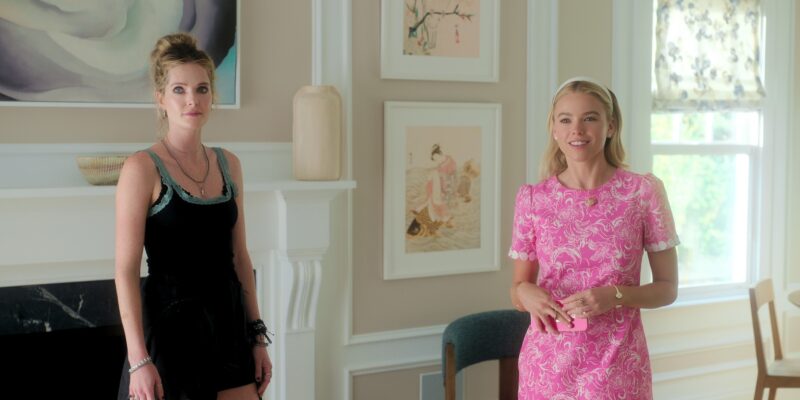
She’s recently gained awards recognition again, this time for Netflix’s dark comedy “Sirens.” Created by playwright Molly Smith Metzler and produced by Margot Robbie’s LuckyChap Entertainment, the five-episode limited series takes viewers inside the quirky world of a luxurious beach estate owned by billionaire Peter Kell (“The Woodsman” star Kevin Bacon) and his enigmatic wife, Kiki (Julianne Moore). Set over one weekend, the story follows the struggling Devon DeWitt (Meghann Fahy) who arrives at the estate to confront her younger sister, Kiki’s assistant Simone (Milly Alcock), only to become entangled in the manipulative dynamics at play.
Here, Kassell details her influences for the “weird” and “wacky” miniseries.
When you reflect on the experience of “Sirens,” where does your mind go first?
To this incredible team we had, from Molly Smith Metzler to LuckyChap [to] our department heads, our crew, [and] the cast. It’s exactly a year ago that we were on location, swimming in the ocean on lunch. It was pretty magical. It’s one of those dream shoots where everyone was all in—good people [who] worked hard and played hard.
What initially drew you to the show?
Molly and LuckyChap, and knowing that I’d be working with these incredible women. Being one of three sisters, I could personally connect with Molly’s script. And then, that it was wildly entertaining and weird and wacky, but also grappling with serious issues—that’s kind of my sweet spot. I love the word “weird” when it comes to the stories I’m working on, and it’s really important to me that it leaves you with something to chew on. This had that incredible combination.
As both the director of the first two episodes and an executive producer, what were your early conversations with the team about, regarding the goals for the show, both narratively and visually?
In my second meeting with Molly, I put together images, because I want everybody to see what I’m seeing—just making sure they know that, if they’re going with me, this is the vision that will be onscreen. So that look book becomes the starting point for conversations with every department head, and I share it with the entire cast and crew; I like everyone to be in on what we’re doing and invested in it.
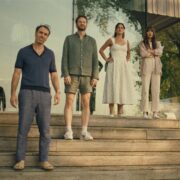
We were creating a fictional island, but how and where do we do that? We were location scouting in Boston and New York, and the last location we saw was the one with the staircase to that house. And that’s a hard location to find and shoot on, and so, in a very early conversation with Molly, I was like, “How important is the staircase?” She said, “Zero to 10, it’s a 12.” And that became shorthand for everything. There are things that were 10s to me, and there are things that are 10s to her. But the minute anything’s a 10 to her, I know to do everything I can to make that come to life.
I can’t even imagine the show without those stairs.
No, they’re everything. And if you’re going to do it, you have to lean into it. They’re obviously the metaphor. As much as it’s a contemporary piece, it is world building. We push the envelope on realism, whether it’s the palette of the costumes or the design of this billionaire estate. And it was really fun to lean into the comedy, uncanniness, and exaggeration of this world.
What were some of your specific inspirations or influences for the show’s visual language?
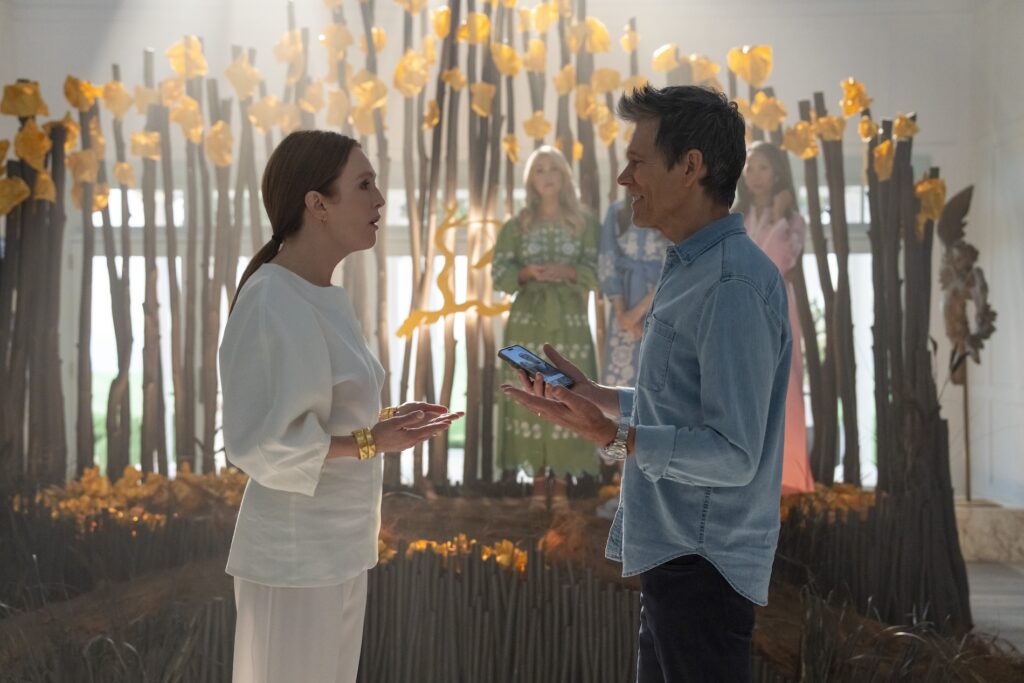
One aesthetic was the extreme closeup that we do between multiple characters. The first time [we did it] was with Julianne and Milly, and we called that “the ‘Siren’ shot.” You’re standing in Simone’s shoes and you feel what it’s like to be seduced by Kiki. The director of photography, Greg Middleton, and I came up with that aesthetic in homage to Jonathan Demme, who was infamous for [it], especially with “Silence of the Lambs.”
And then Alfred Hitchcock. I borrowed from “The Birds” when [on the first episode] we jump cut from Devon looking through the telescope and seeing Kiki, and that kind of psychological zoom in. The parade to the bird funeral was an homage to Federico Fellini’s “8½.” Some very different tonal references, depending on the scene, but they all glue together under the writing.
You got your start as an indie filmmaker before transitioning to TV procedurals, and now you’re working in this “prestige television” world. What’s it been like navigating those ever-changing waters of the industry?
TV allowed me to play in so many different sandboxes. And I’ve managed to not get put in a box, from “The Woodsman” to “Claws” to “Watchmen” to “Sirens.” If I have a signature move, it’s not doing the same thing twice. And each time I have to prove myself. Like, “Can she do comedy? Can she do horror? Can she do sci-fi?”
I have my projects that I’m always working on or developing, whether it’s with other writers or writing myself. And then I’ll be in development and start to get the production itch, and something will come in and I’m off on that tangent. So it’s been a really thrilling ride. It’s kind of two sides of the same coin, where I don’t know what I’m gonna do next—“Oh, shit!”—and on the other side of the coin, where I don’t know what I’m gonna do next—“But look what this is!” And I love it, as much as it is a little anxiety-provoking.
Is there any particular piece of advice you’d give to aspiring filmmakers?
How to get a movie hasn’t changed; it’s equally as hard and mysterious. But you have to do anything and everything you can to get it made. It’s finding your way to show your voice, and the short film still works as a calling card. And write, write, write. Create your own content and just really sink into who you are, because the only thing that’ll set you apart is who you are.
This interview has been edited for clarity and length.