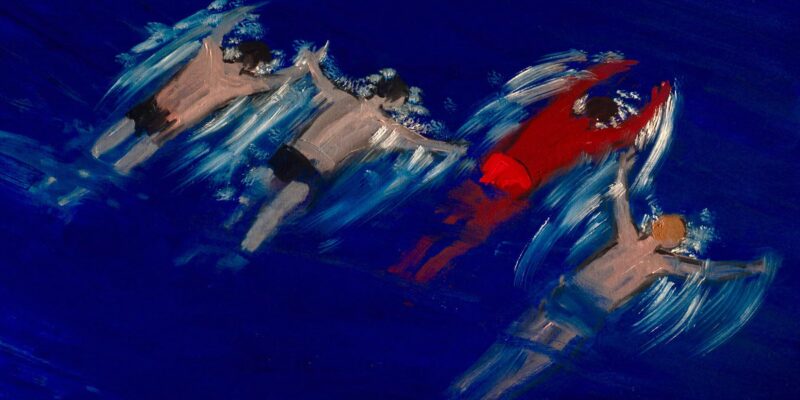
When Florence Miailhe was 10 years old, she had the opportunity to showcase her swimming abilities in front of record-breaking Jewish-French swimmer and Holocaust survivor Alfred Nakache.
“One day Alfred arrived at the beach,” recalls Miailhe, who had been taking swim lessons from Nakache’s younger brother. “My father proudly whispered to me, ‘That’s Alfred Nakache! Show him how you swim the butterfly!’ ” Upon discovering Nakache’s story years later, she was so deeply moved she decided to turn it into an animated short—leading to her first Oscar nomination at 70 years old.
Directed and co-written (with Marie Desplechin) by Miailhe, “Butterfly” (“Papillon”) (2024) traces Nakache’s tragic and inspiring life, from competing in the 1936 Berlin Olympics under the shadow of rising antisemitism, to living through the Nazi occupation of Europe that saw him, his wife, and his daughter deported to Auschwitz. He was the only one to survive. Once freed, Nakache returned to swimming, competing in the first post-war Olympics in London in 1948.
In “Butterfly,” Miailhe uses hand-painted animations inspired by painters from the early 20th century to take audiences on an emotional journey through Nakache’s life, connecting it all to his relationship with water. The poetic meditation on memory, grief, and the resilience of the human spirit won the prestigious Grand Prix prize at the Stuttgart International Festival of Animated Film, qualifying it for an Oscar nomination. Here, Miailhe shares the lessons learned from crafting her film and taking it on the festival submission circuit.
What do you enjoy about working in the world of shorts?
Short films are an incredible space of freedom. You can experiment more, take formal risks, and try ideas that might be harder to defend in a feature. I also love the intensity of the short format. In just a few minutes, you can create a very powerful experience, almost like a visual poem. It suits my way of working well, which is closely linked to painting, sensations, and the transformation of images. After making a feature—which is an extremely long and demanding process—I felt the need to return to shorts…. The short film allows me to maintain a very direct relationship with the material and with the act of painting, which is essential for me.
Sadly, the themes of your film seem just as relevant today as they were at the time in which the story takes place. How did you approach these important and sensitive issues?
What interested me was not turning him into a mythical hero, but showing someone who goes through a historical tragedy and nevertheless continues to live and to pass things on. The period of the concentration camps was particularly difficult to portray. I didn’t want to fall into spectacle or voyeurism. So I chose a very restrained approach, sometimes almost symbolic. For me, the film is also about memory and transmission. Nakache’s story shows that even a champion can be the victim of discrimination and exclusion. Unfortunately, that message resonates even more strongly today.
How have you felt seeing many of these realities reflected in our world at the time the film was released?
It was both disturbing and worrying. When I began working on this film, I thought I was telling a story from the past, a story that was important to pass on to younger generations. I had the feeling that certain phenomena we believed had disappeared were returning in our societies: the stigmatization of certain communities, exclusionary rhetoric, and the questioning of fundamental rights. What once felt like a sense of danger is now a reality. That gives the film a particular resonance. The film also speaks about our present, inviting us not only to remain vigilant but also to fight these deadly ideas that are returning with force…. We are living in a very troubled time, in a world where intolerance, racism, and antisemitism are returning. It is therefore important to remain vigilant, to remember, and to resist so that history does not repeat itself.
Can you talk about the process of circulating the film in festivals and becoming eligible for the Oscars?
One way to qualify for the Oscars is to win a major prize at an international festival recognized by the Academy. That’s why the festival circuit is an essential step for a short film. It’s also the main way for the film to meet its audience. In the case of “Butterfly,” we began with major festivals such as Berlin and Annecy, which helped the film get noticed and circulate through many international events. The Oscars campaign is a particular process, especially for a short film. It involves screenings, meetings with members of the Academy, and a lot of promotional work. For a very handcrafted film like mine, it’s quite surprising to find myself in that context, but it’s also an incredible opportunity to introduce the film to a much wider audience.
What is the biggest challenge when submitting a film to festivals?
Simply existing among an immense number of films. Every year, festivals receive thousands of submissions, so you have to find the right strategy and choose festivals that match the film. But there is also an element of chance. Encounters at festivals, discussions with other filmmakers and programmers, play a very important role in the life of a film.
What advice would you give to other short-film directors regarding festivals and Oscar qualification?
You must truly believe in your project and remain faithful to your artistic vision. The films that circulate best are often those with a strong identity. It’s also important to be well supported by a producer or a distribution team that understands how festivals work. The choice of the first screenings is crucial for the rest of the film’s journey. Finally, you should enjoy festivals as places of encounter. Beyond awards or selections, they are spaces where you can exchange ideas with other filmmakers, discover films, and build collaborations for the future.