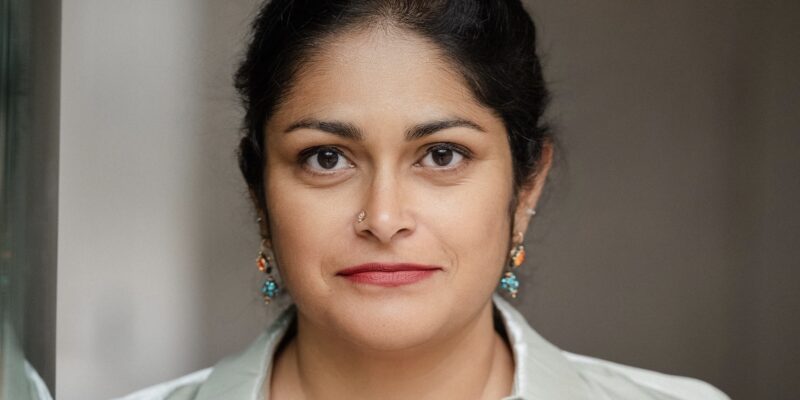
Blazing temperatures, no toilets, and only 21 days to film: These were the conditions under which triathlete, standup comedian, and HarperCollins-published author Anu Vaidyanathan made her feature documentary debut.
“Dispatch” (2026), an 82-minute love letter to self, heritage, womanhood, and Vaidyanathan’s late mother-in-law, explores the Hindu practice of transferring a woman’s identity from her birth family to her marital one. The film was selected for the NFDC Producers Lab at the WAVES Film Bazaar, part of the International Film Festival of India (IFFI) in Goa, in partnership with Storiculture and Netflix. It was produced through Vaidyanathan’s production company, Avani Films, which debuted its nonfiction slate at the festival.
After losing her mother-in-law, Vaidyanathan channeled her grief into the project. “The film follows two families, one from pre-partition India, the other from South India, highlighting a shared human experience across 3,500 kilometres. At its heart is the connection between mothers, daughters, and potentially granddaughters, exploring the sacred ties of this holy trinity,” she told the New Indian Express.
Vaidyanathan hopes her film will help challenge uninformed views of India. “The moniker ‘the third world’ is rubbish,” she tells us. “As the ‘third world,’ we have raised our daughters to be far more outspoken and fiery. These disparities I’m very clear about.” She adds that she was one of five women in a graduating class of 150 at Purdue University, compared to her 3-to-2 female-to-male ratio at school in India. “We grew up kicking boys in the shins and running around until dark,” she says. “We were very competitive. We were never told as daughters to step back. All the stereotypes associated with the culture, I’m sorry, but this film will hopefully break that bubble very quickly.”
The filmmaker draws many parallels between her mother-in-law’s journey and her own in “Dispatch.” For example, her mother-in-law moved from Pakistan with just two bags of rice to her name, and decades later, Vaidyanathan moved to the U.S. carrying only two suitcases. She hopes that emphasizing this connective thread between generations will encourage viewers to walk away from the film with a deeper acknowledgment of the sacrifices their family members made on their behalf.
“I want people to take away the fact that you have to find strength in where you come from,” she says. “It’s a very powerful antidote to suffering. If you knew where your mother came from to put food on the table, whatever the number of things you know about your family, this acts like a salve to any pain or suffering you may face.”
Because of this, authenticity was paramount to Vaidyanathan’s filmmaking process—but it wasn’t always easy for the filmmaker, who found herself questioning her ability to keep the story truthful to her family and faith. In the final days of the shoot, she felt overwhelmed while traveling back to her mother-in-law’s homeland and, in a moment of emotional distress, asked her taxi driver if she had truly done enough as a filmmaker.
“The driver said, ‘You’ve done the most you can do. Have faith,’ ” she recalls. “These words stuck with me in the months to come. You have to somehow see yourself the way others see you. You need to arrive at the point, let go of all control. This is it. Whatever happens now, so be it.”
This sort of relinquishment meant recognizing the full spectrum of human emotion, especially the value of laughter as medicine. Her path as a comedian “was born out of this need to be the woman my parents raised me to be: a direct woman who looks people in their eye and tells them her perspective without worrying about political correctness,” says Vaidyanathan, who studied under the late renowned French professor of theater, dramatic theorist, and master clown Philippe Gaulier.
Interacting with international audiences as a standup comedian further refined Vaidyanathan’s understanding of the delicate intersection between humor and language, which translated into several comedic moments in her feature documentary. “Comedy and grief are bottom emotions,” she explains. “You have to go very deep to find both of them, but I find comedy sits a little below grief, because when you’ve cried all your tears, you can only laugh.”