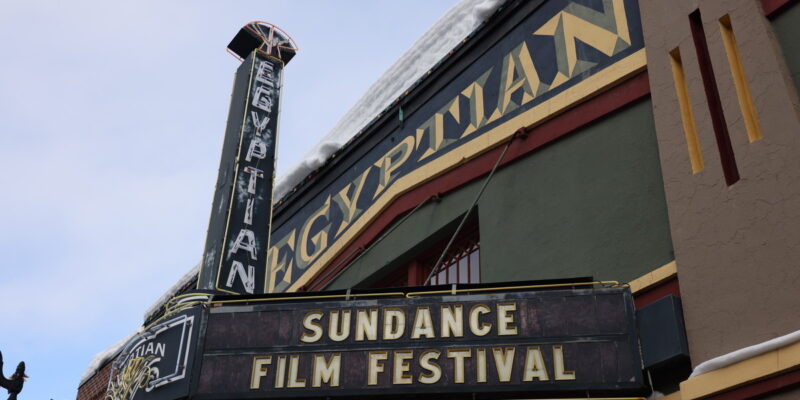
When you walk around Utah’s Park City, it might not immediately strike you as a locale for one of the industry’s biggest film festivals. And yet, over the course of 40 years, the Sundance Film Festival has established itself as a launching pad for tomorrow’s biggest Hollywood talent—both behind and in front of the camera. For the average attendee, you might feel out of place navigating a small mountain town that’s geared more toward winter sports than hosting a massive film fest.
We’ve assembled a few tips for getting around, making sense of the festival, and other practicalities so that you won’t feel so stressed as you figure out Sundance’s screenings and events. While this guide can get you started, keep in mind that Sundance—which runs Jan. 23–Feb. 2, 2025—has some of the best film festival volunteers, and they can usually point you in the right direction if you get lost.
Getting around
It’s important to note that you can’t fly straight into Park City; you’ll have to book a flight to Salt Lake City International Airport and then drive roughly an hour. Be sure to book a shuttle or car service from the airport in advance as other attendees will be making the same arrangements, which can make it difficult to secure last-minute transportation upon arriving in SLC. You can make the journey with Uber or Lyft, but be prepared to pay some surge pricing. We’d also recommend not renting a car unless you’re planning to frequently return to Salt Lake City for screenings and events. There’s a shuttle service operating throughout Park City that will take you anywhere you need to go. Parking within the area is extremely limited; the time you’ll spend trying to find a spot may not be worth the hassle unless you’re staying with a resident who can safely stow your ride.
Speaking of the shuttle service, it’s free for attendees and stops are clearly marked. Also, there should be a volunteer stationed at each stop to help provide directions. Service tends to be fairly frequent and will take you not only to downtown Park City, but to the various venues. There are 13 venues in Park City (although the Redstone Cinemas is a bit of a trek via shuttle, so expect at least a half-hour commute to that venue), and four more in Salt Lake City (like the airport, these will take an hour to reach, so plan accordingly).
The main drawback of the shuttle service is standing in the cold as you wait for the bus, but thankfully there are heat lamps. At this time of the year, temps tend to stay around the low teens and 20s, but you should also prepare for snow. Be sure to check the weather report before you venture out. Nevertheless, bundle up as you make your way through the town. Walking is also an option for some venues, but unless you’re familiar with the area, we recommend starting out with shuttles.

Dining
If you’re staying for more than a couple days, you should get familiar with Fresh Market at 1760 Park Ave., the main grocery story for Park City. The Market is easy to get to (it’s directly behind one of the major shuttle stations), sits next to several theater venues, and is always well stocked. If you’ve rented an Airbnb or another accommodation with a refrigerator, and you’re looking to save on eating out, your first stop after getting settled should be the Market.
If you want to dine out, there are plenty of options. The more expensive restaurants tend to be in downtown Park City, but you can still find good food at a reasonable price. Check out the pizza place Davanza’s, where the seating is tight but the pepperoni pizza is sublime. If you’re in a hurry and want something familiar, there are chain restaurants like Einstein Bros. Bagels and Domino’s, but you can typically do much better; stop at the Mexican restaurant El Chubasco or grab a sandwich at the Fresh Market’s deli counter.
While at the venues, most tend to have concessions nearby, but you’re only allowed to bring water into the auditoriums; so if you want to eat right before a screening, you’ll have to do it standing in line or in the lobby.
Attending screenings
This is why you’re here, right? Before you map out your screening schedule, make sure the venues and films coincide with your badge level and access. Understanding if you’ll need a ticket in addition to a badge will ensure you’re not turned away or find yourself in the wrong line.
One of the primary ways Sundance differs from other major festivals is the sense of discovery. Unlike fall film festivals that are used as a launchpad for Oscar hopefuls, Sundance is a word-of-mouth festival where, although there are recognizable directors and actors in the lineup, breakthroughs can come from anyone or anywhere. This means that you should go in with a plan for the movies you want to see, but you also have to be willing to discard that plan if you start hearing good things about a particular film that wasn’t on your radar. Expect the festival lineup to be announced at the beginning of December, and keep an eye out for the Sundance app soon after for access to the program guide and screening schedule.
Remember: You don’t go into Sundance already aware that films like “Beasts of the Southern Wild” or “CODA” are going to take the festival by storm, but you should be open to the possibility. And keep in mind that as an attendee, your voice is going to carry more weight for any movie that’s looking for distribution. You represent the first wave of viewership, and social media is an important tool, not only for getting other attendees to go see a movie you loved, but also for raising awareness among buyers looking to make acquisitions.
While you’ll be standing in line for a fair bit of the festival, this is a great opportunity to adjust your schedule. Strike up a conversation with your fellow festivalgoers; ask them what they’ve seen that they’ve liked and what they’re looking forward to. It’s all well and good to check social media reactions, but you can share your love of film in person with a stranger and maybe make a new friend!
Also, if you miss a screening of a film that becomes the sensation of the fest, don’t worry. Sundance is quite good about adding screenings of hit movies, so even if you’re not among the first to see a film, there’s a high chance you’ll have another opportunity later in the festival if you stick around. Furthermore, all movies that receive awards at the end of the festival receive an additional screening.
Finally, Park City is a small town that transforms itself around a major film festival. That means showing movies in venues unlike traditional movie theaters. You may find yourself at a screening at a school or a library auditorium, and while the projection and sound is always pristine, you may find the seating a bit cramped, especially as you take off a puffy coat or a backpack. That’s not to say that the experience is unenjoyable; just don’t go in expecting big reclining seats like you see at major theater chains these days.

Knowing your stamina
One final note: Know yourself. It may not seem that exhausting to sit in a chair for most of the day while you watch movies, but Sundance fatigue is real, and you should pace yourself so you can maximize your enjoyment. Unless you’ve got a badge that will send you to the front of the line every time, then you need to remember that a sizable chunk of the festival is arriving early to screenings and then standing in line. If you try to do this for four movies per day, every day, you might be exhausted five days into the festival. If a film isn’t getting good buzz or it no longer holds your interest, there’s nothing wrong with taking a break. Watching as many movies as you can is a fine goal, but it can backfire if you’re too tired to keep your eyes open.
Also, remember you’re at a higher altitude, and even if you don’t get immediate altitude sickness, staying hydrated, staying warm, and eating carb-heavy foods can help alleviate symptoms. Furthermore, you’re in the mountains and may find yourself having to walk uphill to reach a screening or a shuttle stop, so don’t push yourself too hard. If you need to rest, then rest! A film festival is a marathon, not a sprint.