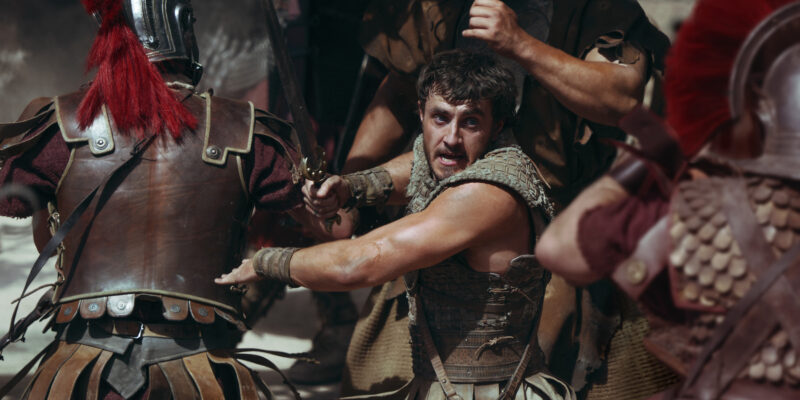
A lot has changed in the 24 years since Ridley Scott’s “Gladiator” graced our screens, both in filmmaking technology and in the real world. This is readily apparent in “Gladiator II,” the director’s long-awaited sequel to his best picture–winning sword-and-sandals epic. Cinematographer John Mathieson returns for the follow-up, using updated digital tools to tell a darker, more violent story that comments on the rise of modern authoritarianism.
The film stars Paul Mescal as Lucius, the now-grown son of Maximus (Russell Crowe) and Lucilla (Connie Nielsen). Lucius is an enslaved warrior who has a bone to pick with the Roman elite. He teams up with Macrinus (Denzel Washington), a scheming arms dealer, to navigate the halls of power. While the original film captured the grandeur of Rome, the sequel takes an unflinching look at its darker side, presenting a ruthless, hedonistic version of the ancient city, where bloodthirsty corruption has reached a fever pitch.
This sense of gritty nihilism begins with the cinematography. Mathieson discusses his approach to crafting a sequel that feels in line with the original even as it blazes its own path.
The depiction of the afterlife in “Gladiator II” is a stark departure from the original’s golden fields of wheat. Here, the world is drained of color and rendered in silvery tones. How did you decide on that look?
Ridley dug out pictures for reference. One was a surrealist photo by Bill Brandt of an ear on the beach. And then there’s Man Ray, who was a great point of reference, alongside Lee Miller, his muse and collaborator; they invented solarization [a process which inverts dark and light tones]. So what you see there is black and white. We got some black pebbles and wet them to make them blacker; then, guys came in and spray-painted them silver. Then we put down a mirrored floor to get reflections over the still water, and we used blue screen to put in this very moody, troubled sky.
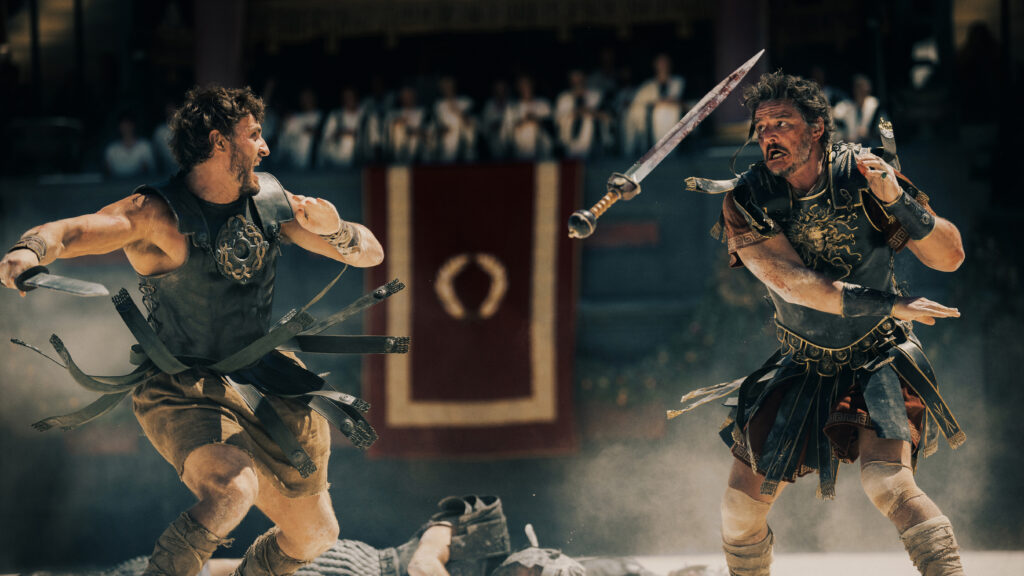
This is a fiery film, both in terms of the performances and lighting. How did you approach that as a cinematographer?
Well, nothing’s actually lit by flame. You can do that, but the trouble is that it comes out very, very red or orange, photographically. So what you do is you hide [the firelight with] other sources around it; you light the flames. If you look at a flame, it will look quite white, so we hid lights in and around the edges, sometimes even putting them at the base of the fire itself. They’re usually just little things like domestic bulbs, and then we put them through a dimming pattern. We put them low down and shoot them across the actors’ faces. We make them dance a bit, which flame doesn’t actually do; it’s much stiller than people think it is. But it just looks better if you make it dance.
It’s been more than two decades since the release of “Gladiator.” How did you maintain a sense of visual continuity while also updating the look of the world?
There are a lot more scary characters around us in “Gladiator II.” Corruption is rife; it really feels like the fall of Rome. So I lit it kind of decadently—really over-the-top—[to create] a faux-Vegas look, with a huge amount of wealth and gaudiness. You can imagine a few dictators’ palaces looking like that inside.
Obviously, we shot on digital [this time instead of film], and that’s different, but not really at its core. We knew we had to continue this story, but maybe it’s not so down and earthy. In Maximus’ story, you travel [alongside] him through the war to being captured and living in North Africa to going to Rome. But really, he’s always a prisoner. “Gladiator II” [takes place] a lot more in the palaces where treacherous meetings are going on. And Denzel is just this brilliant, demonic character, but you’re rooting for him.
The fights in the Colosseum are more over-the-top: the water, the colors, the smoke, all the people drinking wine. It’s very gaudy, and it’s great fun. It looks great, all the color and vibrancy, which we didn’t really have so much in the first one. But that’s not really me; that’s actually the art direction. People think it’s the camera, but it’s what you put in front of it.
This interview originally appeared on Backstage and has been edited for clarity and length.