When “Hamnet” (2025) was first offered to Chloé Zhao, she wanted to pass. It had been four years since her last film, Marvel’s “Eternals” (2021), and Zhao—who earned two Oscars for bringing nomadic America to life in “Nomadland” (2020)—was deep in what she described to “The Interview” podcast as a midlife crisis. Yet it was exactly this moment of existential questioning that would intimately connect her to the film.
“Hamnet,” a fictionalized account of William and Agnes Shakespeare’s marriage, is adapted from Maggie O’Farrell’s acclaimed 2020 novel of the same name, with a screenplay written by Zhao and O’Farrell. The story follows William (Paul Mescal) and Agnes (Jessie Buckley), two outcasts of their own families who fall into a feral kind of love. After the death of their 11-year-old son, Hamnet (Jacobi Jupe), the couple navigate their agonizing grief, which tests their love for each other and for life itself. And from that grief, Will creates “Hamlet.” Here are the lessons filmmakers can learn from Zhao’s work on the eight-time Oscar-nominated film.
Find a personal way into the story.
When Zhao was initially offered the film, she didn’t feel like she was the right choice. “I didn’t think I had the life experience to tell the story,” she told the Hollywood Reporter. She assumed the project would center on Shakespeare’s “Hamlet,” a darker tale of death and madness.
It was not until she read O’Farrell’s novel that Zhao understood how deeply she resonated with “Hamnet.” What she found there was the character of Agnes—a woman who expresses a full spectrum of emotions without shame and who exists in her body rather than her intellect. Zhao recognized in Agnes a consciousness she had been working to access in herself for years but had never put onscreen. “That part of me, that character, does not exist in my films until this one,” she told Deadline. “I knew I was working on bringing her through myself for about four years, and then I was ready to do this film.”
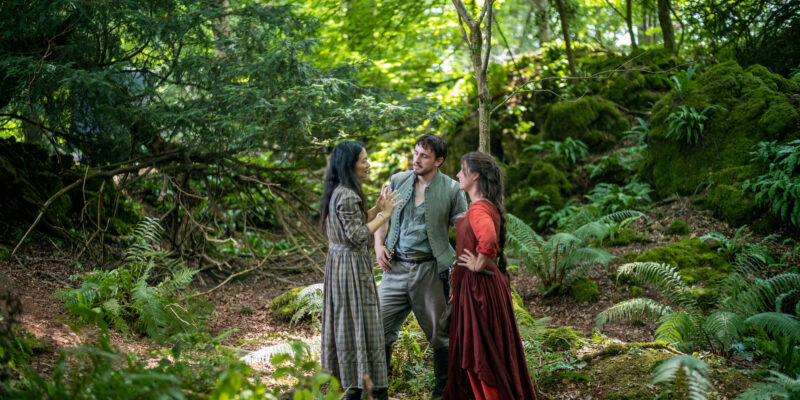
That personal reckoning became the lens through which Zhao made her directorial decisions. Alongside her costume and production design teams, she assigned Agnes the color red, which she told Yahoo represents the root chakra: earthy, embodied, and alive. By contrast, Will appears consistently in blue, evoking the intellectual and the ethereal. After Hamnet dies, color is stripped entirely from Agnes and Will’s bedroom—a wordless yet visceral depiction of grief.
Zhao spent roughly six days filming Buckley’s reactions to capture the film’s climactic Globe Theatre sequence, when Agnes watches “Hamlet” performed for the first time and slowly realizes that her husband has transformed their son’s death into art. “We knew, even from the book, it is going to be Agnes’ experience,” Zhao told Deadline, “so we had been filming her face for about six days leading up to that. But also on her face, that is where the audience are going to be.”
Oftentimes, the question behind making a film is “Why should this story be told?” But for a filmmaker as intentional as Zhao, the question to begin with is: “Why should I be telling this story?” The ability to answer that question is what makes direction emotionally immersive.
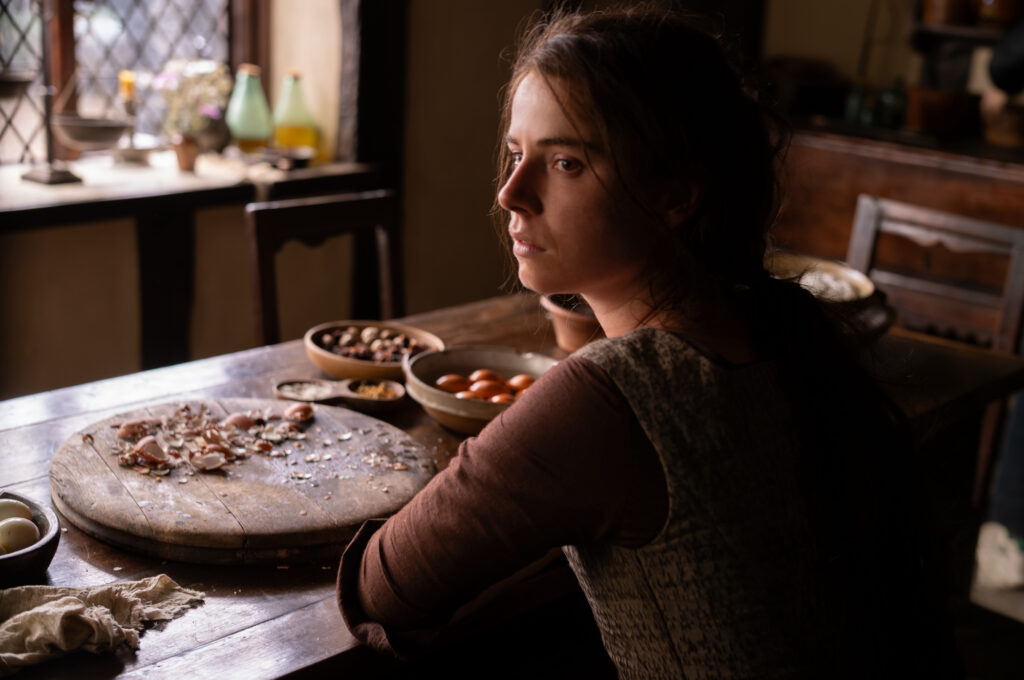
Jessie Buckley stars as Agnes in director Chloé Zhao’s HAMNET, a Focus Features release.
Credit: Agata Grzybowska / © 2025 FOCUS FEATURES LLC
Think in circles.
Once Zhao committed to “Hamnet,” she almost immediately hit a wall with the opening. “For me, the beginning of a script is always the hardest to write,” she told Bradley Cooper for Interview magazine. “I don’t know how to start films, because I feel like the beginning and ending isn’t a line, it’s a circle.”
Zhao left the beginning of the script open, which gave her space to find the right opening shot after the rest was written. She explained to Cooper that shortly before scouting locations in Wales, she had been in Kyiv, visiting a filmmaker working on the frontline of the war. The forests there were scarred with holes from landmines and military dugouts. When she eventually arrived in Wales, she scouted a forest with naturally occurring holes in the dirt beneath the trees, bringing her back to those images. “I just sobbed and sobbed by this hole, feeling like death in some way connects us,” she explained. “Somehow it became clear to me—this hole has to be at the beginning of the film.”
Opening with this image plants the seed of death: a feeling that shadows the narrative through every season of Agnes and Will. From their budding love to their growing family, the inevitability of winter looms over the story until it finally arrives. But even when Hamnet dies, Zhao doesn’t leave us there. The momentum built through her circular storytelling generates the anticipation of seasonal change. Will faces the death of his son and turns to his art to process his grief. And when he finally reveals “Hamlet” to Agnes and the world, they arrive at death again, but with a different perspective.
Use a holistic approach to actor preparation.
A story as traumatic and emotional as “Hamnet” required Zhao and her collaborators to enter difficult territory together. To help ensure their choices “came from the body, not from the mind,” as she told the Hollywood Reporter, Zhao enlisted what she called “ancestral wisdoms,” she explained to IndieWire. These techniques—ranging from group dream work with large casts of extras to tantric energy workshops with her leads—were designed to get the cast working from a place of physical intuition rather than intellect.
To film a particularly emotive scene when Agnes and Will clash as he prepares to leave for London alone shortly after Hamnet’s death, Zhao skipped rehearsals entirely. Instead, the director—who has trained as a tantric practitioner—had Buckley and Mescal partake in an energy workshop designed to let them “feel safe to be in their most extreme polarity of their gender,” she told Vanity Fair. The result is a scene that deftly captures the ways trauma can split a couple open. Each person’s survival mechanism becomes the very thing that deepens the other’s pain. Will’s need to flee into his work feels like abandonment to Agnes; Agnes’ refusal to let the loss be minimized feels like an accusation to Will.
Zhao’s ability to build containers in which her collaborators can access something deeper than performance is what makes “Hamnet” exceptional. Every technique serves to strip away the intellectual and arrive at something visceral. It’s a major directorial accomplishment, and a reminder that creative inspiration can come from traditions far older than cinema itself.