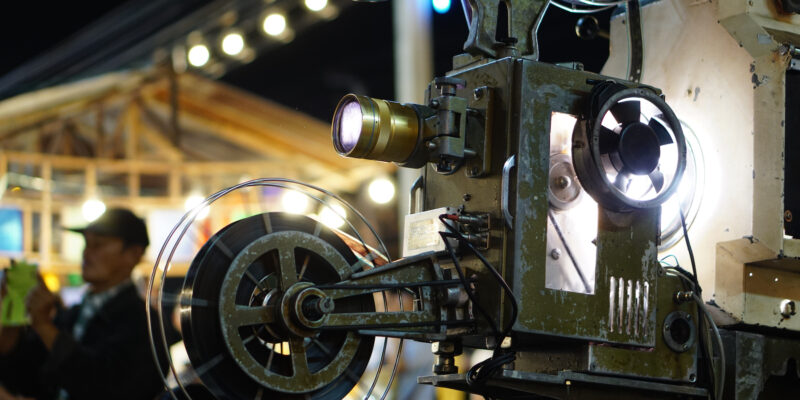
As the largest event for short films on the East Coast, the DC Shorts International Film Festival has been showcasing projects in Washington, D.C. for 22 years. Each year, over 1,300 submissions from more than 100 countries are whittled down to 145 selections, which then compete for seven awards. In recent years, the fest has risen in prominence and popularity, regularly selling out each of its screenings, parties, and panels.
An ever-evolving festival
DC Shorts programming director Joe Carabeo says he wanted to “revive and refresh” the festival for its 20th anniversary in 2023. A filmmaker himself, Carabeo also runs the Awesome Con Short Film Festival.
Carabeo immediately saw the potential in DC Shorts, especially as it unfolds at the Alamo Drafthouse near the city’s lively Bryant Street Market. “It’s a cool hangout spot,” he says. “That’s where we are holding our panels this year. We are deciding whether to have a DJ or a band. But there’s amazing food, restaurants, and bars there. We want it to be this creative hub.”
By holding the festival in such a vibrant place, Carabeo is hoping that the atmosphere resembles that of Austin’s South by Southwest: “We want to take over the whole street in the future.”
Diverse film selections
Carabeo’s first piece of criteria for festival selections is that the films have the requisite production and technical quality—especially since mistakes and blemishes can easily be spotted on the big screen. He’s a stickler for this, explaining he doesn’t “want to make another filmmaker look bad because a production doesn’t meet up to it.”
He also looks for films with a distinct vision and voice. “Each film has to have a moment that makes me sit up and realize why I’m watching it,” he says. “I grew up watching Kevin Smith and Quentin Tarantino films come out of Sundance. I want the films to feel dangerous and unmanageable. They can be imperfect, but they need to look really cool and be fun.”
While the festival screens shorts from all over the world, Carabeo takes pride in mixing them with local films from D.C., Maryland, and Virginia. “There are some amazing creatives in this area,” he says. “It’s not just politics and news. It’s about time the DMV had its moment to shine. It just takes one movie to break out and create buzz.”
He also compares programming each block of short films to creating a playlist—he’s always looking for an eclectic mix. “We have a certain amount of time we need to fill,” he explains. “Sometimes it’s like, ‘We need five more minutes!’ That’s when we see your five-minute film that you didn’t think was good enough, but we actually think it’s awesome.”
At the end of the festival, awards are handed out for outstanding genre, comedy/drama, animated, use of music, documentary short, first-time filmmaker, and local film. Each of these categories are judged by industry professionals that work in a variety of different roles, from producers to directors to editors.
Opportunities to build community
Carabeo hopes that DC Shorts gives filmmakers the chance to build and grow their own community of like-minded cinephiles. “I really want people to connect through their films,” he says. “This medium is so impossible. It’s a miracle that people get their films made at all. So it’s worth celebrating when they’re done well.”
One way to connect is through the event’s informative Q&A sessions. After each block of screenings, the creatives behind the shorts are asked to field questions about their productions. Carabeo encourages those participating to really take advantage of this platform so that they can promote their work and build their audience. “I’ve been to panels and conventions where Bruce Campbell and Kevin Smith speak for a hugely entertaining hour,” he says. “They educate people on their film, tell amazing stories. These panels are an opportunity for the audience to learn about the filmmaker, their world, and their work. I want to capture that energy.”
Directing and cinematography teams, production assistants, and other crew members are also invited to discuss their collaborative processes, first on-set experiences, paths to success in the industry, and, as Carabeo says, the “nitty gritty of working in film.”
As an experienced filmmaker himself, Carabeo is well aware of just how tumultuous and costly submitting to festivals can be. But he always encourages directors that are on the fence to “just submit.”
“Being in the room when your film is screening is so important,” he says. “That’s why I love putting on film festivals. It gives directors the theatrical experience. I know it can be super scary. But it’s also super enjoyable to be in the same room as a stranger watching your film.”
By bringing filmmakers together and supporting their work, Carabeo hopes to encourage them to stay motivated and keep making movies. “Watching films sitting in a theater is much more inspiring than watching them at home on a computer,” he says. “I just want people to keep making cool and important stuff. Because you never know who might watch it and where that can take you.”
DC Shorts International Film Festival’s next run takes place Sept. 4–6.