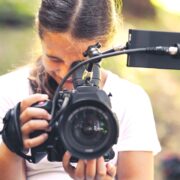
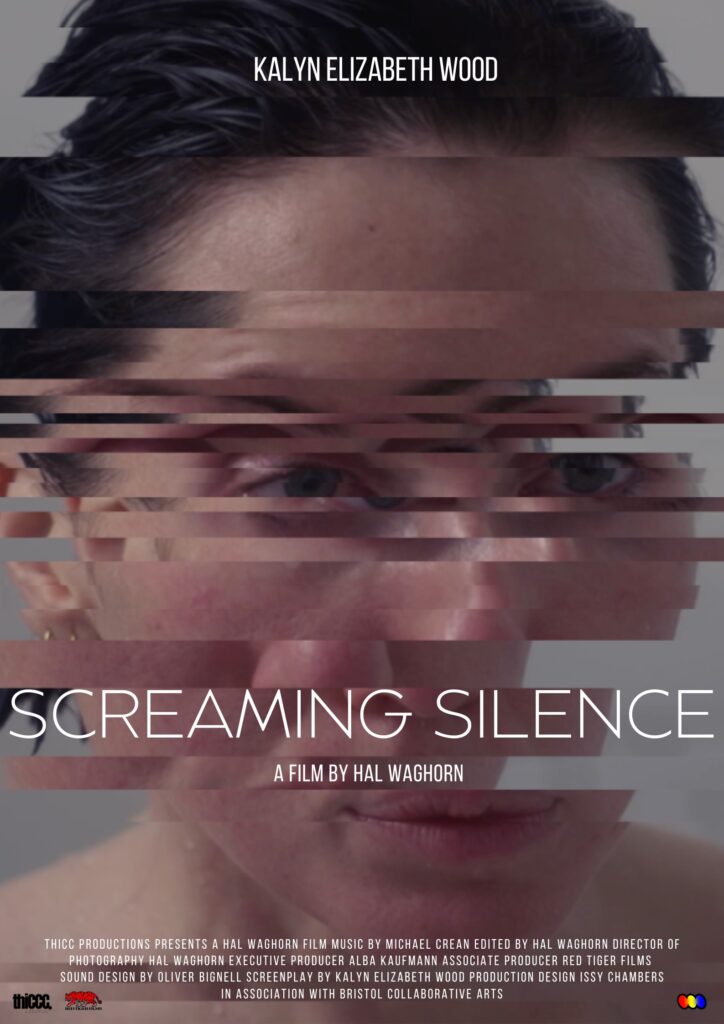
Kalyn Elizabeth Wood never intended for “Screaming Silence” to be anything more than her master’s dissertation project. The haunting, dialogue-free film follows a woman (Wood) who isolates herself while processing a traumatic event and an unwanted pregnancy. Shot in just two days with a skeleton crew after COVID-19 sidelined her original team, the short has since won over 25 festival awards and connected with audiences worldwide. Wood says that making the film taught her invaluable lessons about the industry—and about herself.
The filmmaker learned flexibility by doing, not (over)thinking.
Although filming “Screaming Silence” commenced under less-than-ideal conditions, Wood didn’t let the initial roadblock waylay her journey; instead, she adapted. She sent her script to director-editor Hal Waghorn, who was immediately on board, and they shot the entire project in under 48 hours.
“I kept saying to myself: It’s going to get done because it has to get done,” Wood says. “I think anytime I overthink something, I try to control it, and it never goes to plan. And in this circumstance, the film is so intimate and we had to shoot it so quickly.” This meant Wood and Waghorn had to build trust quickly—which ended up making all the difference.
“I truly believe when you do the work and then you just leave it and you walk on set, it’s there,” Wood continues. That philosophy of preparation followed by release became crucial to bringing “Screaming Silence” to life.
She took a leap—and found her audience.
Once the film was complete, Wood submitted it for her degree and considered that the end of the story. But after her mother, agent, and producer friend all pushed her to do something more with it, she found herself asking Waghorn: “Want to submit [the film] to festivals? What do I do? He was the one who said, ‘You need to get FilmFreeway.’ I was like, ‘What the heck is FilmFreeway?’ ” Wood says with a laugh. “And he goes, ‘Well, every festival is on there. You have to go through it to submit it.’ And I was like, Oh. I didn’t know what I was doing.”
Thankfully, submitting to festivals was “a seamless process,” Wood says. “I uploaded everything. It told me if my aspect ratio was off, and then I just spent about a week, maybe two weeks, looking at all the festivals and saving them.”
Wood started small with experimental festivals, then got bolder, submitting to events like Wildsound Feedback Film and Screenplay Festival, IndieX Film Festival, and Phoenix Rising International Film Festival. The results exceeded her expectations. “We won, which was great. I now have a bunch of trophies,” she says. More importantly, she connected with other filmmakers and was even asked to serve on the judging board for the next Phoenix Rising fest.
Her advice for filmmakers when it comes to festival submissions is: Do your research—but also just go for it. “Be like, ‘I’ll just do it,’ ” she says. “Why not?”
Among Wood’s many festival experiences, one that stands out the most is the response she received from a blind veteran documentary filmmaker. “When I get down to the Q&A, this man is in pieces. He is just so emotional,” she says. “And he’s the first one to ask me a question—or it wasn’t even really a question. It was a statement. He said, ‘I’m blind, and all I had to do was listen. And I am torn to pieces by what I heard.’ That moment as an actor, but also [as] someone who just simply created something—that someone can be moved like that without even seeing it, I kind of was like: I can be happy with this and go home.”
She received similar reactions from assault survivors of all genders. “Having women and men who’ve experienced any form of assault coming up to me and saying, ‘Thank you, you captured it, you get it,’ always makes me so emotional, because that’s why I do it,” Wood says. She believes that the authenticity of these responses stems from her creative intention for the film. “I wasn’t making it for anyone else but myself,” she explains. “I wasn’t making it with men in mind, not even other women in mind. I was just making it for me.”
She realized the importance of self-trust and perseverance.
For years, Wood heard from agents and casting directors that she was “a tough sell” due to having a unique look. Although she initially tried to conform to what she thought the industry wanted, making her own film changed that. “It gave me authority over myself,” she explains. “And what I mean by that is not in terms of who I am, but in how I want people to perceive me.
“It reinvigorated something inside me from when I was a child, of just doing,” Wood continues. “And it drove me to have more confidence on the business side of everything.” That confidence led her to self-submit to a manager and get signed, and to advocate for herself in ways she hadn’t before.
“Be yourself and sell that,” she says. “Don’t sell the version that you think that they want because if they pass on you, they pass on you.” And if you struggle finding your footing in the industry, she advises, “Do it for yourself. Make the thing. Write the thing you want to read. Because if you can’t find it out in the world of what you want to read, write it. And then that hole will be filled. But you’re going to be filling it.”
Wood’s final piece of advice is to remember that when things are tough, say to yourself, “This too shall pass.” “Keep going,” she says—because you never know what wonderful, unexpected opportunity is just around the corner.
This interview has been edited for clarity and length.