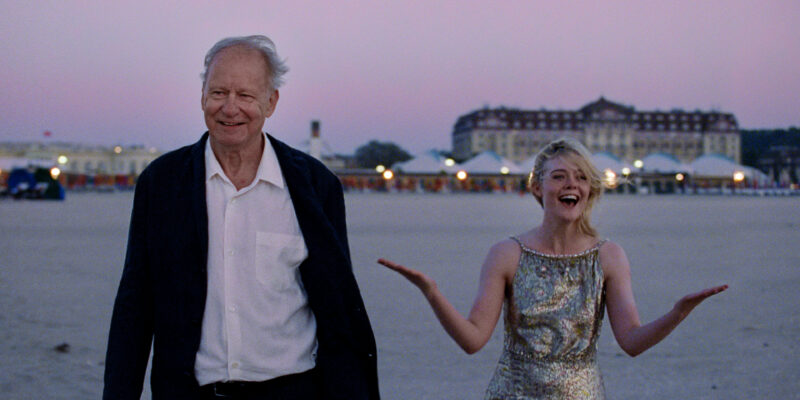
When Gustav Borg (Stellan Skarsgård) attempts to reconcile with his estranged daughters, Nora (Renate Reinsve) and Agnes (Inga Ibsdotter Lilleaas), in the 2025 drama “Sentimental Value,” he does what filmmakers do best: He turns their shared trauma into art. Director Joachim Trier, who co-wrote the script with Eskil Vogt, portrays the family’s intimate, moment-to-moment emotional shifts alongside the long shadow of generational trauma and childhood wounds.
The Norwegian film, which earned nine Oscar nominations, traces the fault lines of the Borgs following the death of Nora and Agnes’ mother. Gustav’s desire for reconciliation quickly entangles with his art when he offers Nora the lead role in his next movie. Soon, that invitation becomes an examination of familial relationships, traumatic history, and creative intent.
Here are four lessons filmmakers can glean from Trier’s quietly potent family drama.
Try out interesting expositional approaches.
“Sentimental Value” opens with a narrator describing a school assignment written by a young Nora from the perspective of her family’s house. Initially, the exercise is playful: Nora wonders if the house feels pain, if its walls are ticklish, and if it’s happier when it’s full of people. But beneath that lightness, Trier is already laying a foundation that frames exposition as perspective, allowing familial context to emerge indirectly.
Trier told IndieWire’s Filmmaker Toolkit podcast that the scene was a way of “smuggling in” the idea that this is a family shaped by conflict, showing “a family where the parents argued a lot.” Establishing dysfunction through the lens of the innocent Nora introduces the house as a central presence and communicates that the story will deal with heavy material such as loss, estrangement, and generational pain—but will do so obliquely. That same restraint of letting perspective do the work extends throughout the entire film.
Use empathy as a framework.
The film works precisely because Trier isn’t interested in explaining his characters so much as understanding them. The director told IndieWire that he tried to “speak truthfully and earn the emotions” by resisting the urge to clarify motivation, allowing desire to stay messy and lived-in. His process begins with identifying and understanding a character’s “yearnings and struggles,” he explained to RogerEbert.com. “That’s not the same as saying that the characters are biographically like me.”
His approach shapes each character, particularly Gustav. Trier’s recognition of the turbulent terrain of a filmmaker’s life is clear in his depiction of the thrill of creation, the fear of irrelevance, and the absence that a life in moviemaking can create at home. This allows Gustav to exist as more than an archetype; he’s a man driven by his competing desires to keep making work and to also reconnect with the daughter who has kept him at arm’s length.
When Gustav first asks Nora to star in his film, for instance, the exchange is awkward and brief. They sit across from each other in a bar booth; he brings out a thick script; she refuses and leaves. Most directors would cut there—but Trier doesn’t. Instead, the camera stays with Gustav as he remains alone, embarrassed, and deflated. It’s a small moment but a revealing one. By lingering after the conflict has technically ended, Trier shifts the drama inward. The question becomes less about Nora’s refusal and more about Gustav’s motivation. Is his disappointment rooted in his film, or in the failure to connect with his daughter? That ambiguity, introduced early on, is what pulls us in.

Explore the power of location.
Trier charges the spaces of “Sentimental Value” with poignancy through repetition and lingering camerawork. The hallway leading to the room where Gustav’s mother took her own life recurs throughout the film, framing conversations long after its significance is revealed. Each return to the hallway deepens its weight with knowledge that the characters themselves rarely articulate—a weight that grows heavier as we learn that Gustav intends to shoot his new movie, about a mother who takes her own life, in this very house. The location becomes layered as personal history and creative intent collapse into the same space.
Much of “Sentimental Value” unfolds inside the Borg family home, which Trier portrays as shaped by the residue of time and memory. From the opening scene, the house is positioned as a witness—one that outlasts the people inside it. Space, in this film, remembers.
The best filmmakers have the power to make audiences “be, experience a place, a space in the movie… you can almost smell it,” Trier told IndieWire. The film’s cinematographer, Kasper Tuxen, echoed that philosophy, telling the Film Stage that they sought to create a visual language that is deliberately “character-driven,” designed to make the audience feel “connected, not removed from the characters,” especially in how they relate to the space. Through repetition, framing, and restraint, the house stops functioning as background and becomes emotional infrastructure—a familiar space that quietly holds unresolved trauma.
Build intimacy with the sound of silence.
One of the most affecting scenes in “Sentimental Value” unfolds when Nora and Agnes quietly reckon with their shared childhood after Nora finally reads Gustav’s screenplay. There’s no score beneath the dialogue; the silences are allowed to breathe.
“I tried to really build towards that feeling of presence: being there, hearing the breathing, all the movements of clothes,” Trier told RogerEbert.com. “That can ultimately be so strong.” The quiet noises made by the characters place the audience inside the room with them, until the tenderness nearly becomes tangible.Trier—whose father was a sound technician—draws the audience closer by remaining quiet at the film’s climax, allowing us to simply be there. He’s invested in “going into those intimate, more tender emotions in this world,” he explained to Letterboxd. In “Sentimental Value,” that shift toward tenderness becomes Trier’s defining strength, allowing quiet moments to land with just as much force as cinema’s largest spectacles.