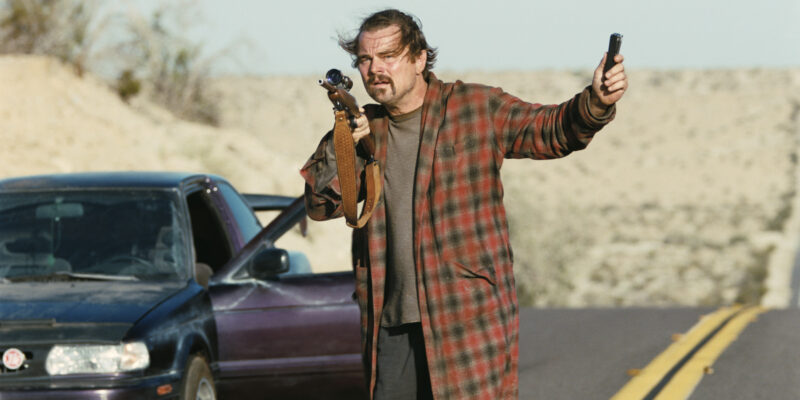
In a genre riddled with redundancy, Paul Thomas Anderson’s “One Battle After Another” carves out something singular. The 2025 action thriller follows washed-up revolutionary Bob Ferguson (Leonardo DiCaprio) as he scrambles to reunite with his spirited daughter, Willa (Chase Infiniti), after they’re forced into hiding when Bob’s militant foe Col. Steven J. Lockjaw (Sean Penn) resurfaces after 16 years.
Though “One Battle After Another” has all the hallmarks of an action movie, PTA’s visionary approach brings a fresh take to every genre he touches, from romantic comedies like “Punch-Drunk Love” (2002) to historical fiction like “There Will Be Blood” (2007). At the crossroads of genre and auteur filmmaking is a wildly entertaining, high-octane story portraying sympathetic characters against an all-too-relevant political backdrop. Let’s look at some of the ways Anderson made one of the best films of his career.
Learn from the masters.
Every great film has its debts, and “One Battle After Another” is no exception. Most obviously, the film is an adaptation of Thomas Pynchon’s postmodern 1990 novel “Vineland,” but Anderson was also influenced by several classic films.
According to gaffer Justin Dickson, the film is an homage to the low lighting used in William Friedkin’s “The French Connection” (1971). He told Aputure that this helped keep the crew “honest in approach, technique…visual language and visual style.”
To build on this honest vibe, Anderson looked to Gillo Pontecorvo’s “The Battle of Algiers” (1966), a neorealist war film that Bob watches while hiding away at his cabin in “One Battle After Another.” Many of the performers in “The Battle of Algiers” are “nonprofessional actors [or] people recreating the experiences they’ve had,” Anderson told TCM. “That’s what makes [the movie] sing.”
Casting real-life military consultant and former Homeland Security special agent James Raterman as chief interrogator Colonel Danvers, and actual high school students to play Willa’s classmates, helped the director attain the film’s gritty, realistic quality.
Anderson then turned to Richard Boleslawski’s “Les Misérables” (1935) to craft his movie’s temporal structure. “One Battle After Another” had to establish the expository events of a revolutionary militia while also depicting the relationships between its main characters and diving into Willa’s story. Anderson entertained the idea of a nonlinear structure with flashbacks, but it never felt right. “I remember seeing [‘Les Misérables’] and feeling like: That’s what we should do,” Anderson said in an interview with De Estreno, citing the large time jump between its “crazy” first and second acts. Using a similar linear technique in “One Battle After Another” created “an emphasis on the child 16 years later,” he explained.
It’s all about location, location, location.
“One Battle After Another” is set in an anonymous American city that lacks distinction yet feels completely unique, unifying locations spanning the entire West Coast of the U.S. into something cohesive. How did Anderson pull this off? Through diligent and relentless location scouting.
The scouting process took the production team “from the redwoods to the desert,” production designer Florencia Martin told Condé Nast. The scout began in 2022, spanning more than 25 cities in California alone. Anderson prioritized locations like Sacramento, El Paso, Eureka, and Humboldt that had not yet graced the silver screen in major ways.
Diligent location scouting also contributed to the film’s mesmerizing, nauseating final chase scene in which cars race down a road rising and falling over desert hills. Anderson told the Directors Guild of America that the team found the “river of hills” on a drive during location scouting between Borrego Springs, California, and the Arizona border.
Martin explained, “We got on this highway that started to descend and ascend, and all of a sudden we all just stopped and said, ‘So this is something really special.’ ” Anderson began filming on his phone, and the location sparked the idea for how his film should end.
Focus on storytelling first.
Though he may be known for his iconic shots—think of Joaquin Phoenix draped over the deck of a ship in “The Master” (2012), or the silhouette of two lovers against the chaos of a New Year’s Eve party in “Phantom Thread” (2017)—Anderson believes that visuals must serve the story first. “Sometimes it’s OK to not be gourmet in your photography,” Anderson explained to De Estreno. “You’re there to tell a story.” The “strongest thing,” he believes, should be “the story, the script, the people.”
To help create a character-centered visual language, Anderson and cinematographer Michael Bauman filmed with VistaVision, aiming for a natural style rather than a highly stylized look. “It was a lot of naturalism,” Bauman told the Motion Picture Association. “That was the whole thing on this job. Paul was like, ‘Look, nothing should look perfect. Nothing should look like a movie. It’s got to have this ’70s vibe.’ ”
Trust your actors and create space for collaboration.
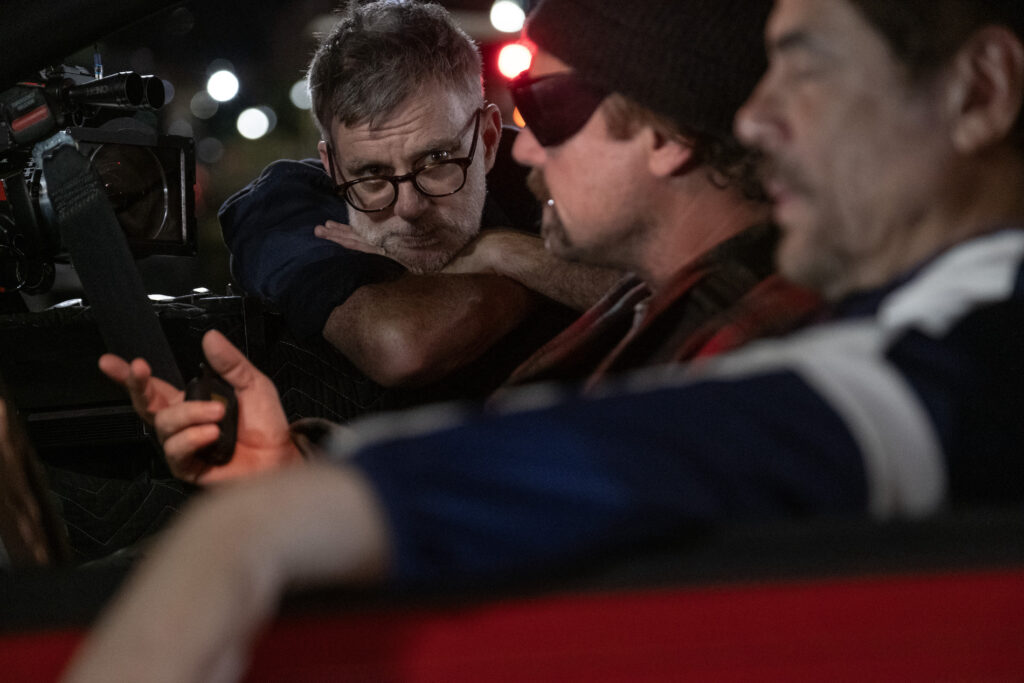
Anderson’s approach to “One Battle After Another” was far from the rigidity often ascribed to writer-directors; instead, he sought to invite creativity and spontaneity. “It’s always important to walk in having a plan that you’re prepared to throw out the window if the actors find something in the space,” he told De Estreno.
For instance, although the filmmaker originally decided that there would be no phones in “One Battle After Another,” he changed his mind when Infiniti and DiCaprio disagreed. Following their pushback, Anderson decided that cell phones should not only exist, but even play a major role in the plot. “I felt that he was very malleable with actors,” DiCaprio explained to Esquire. “He really loves working with actors, and if you have input or feel like you want to go in a different direction, he’s open to that.”
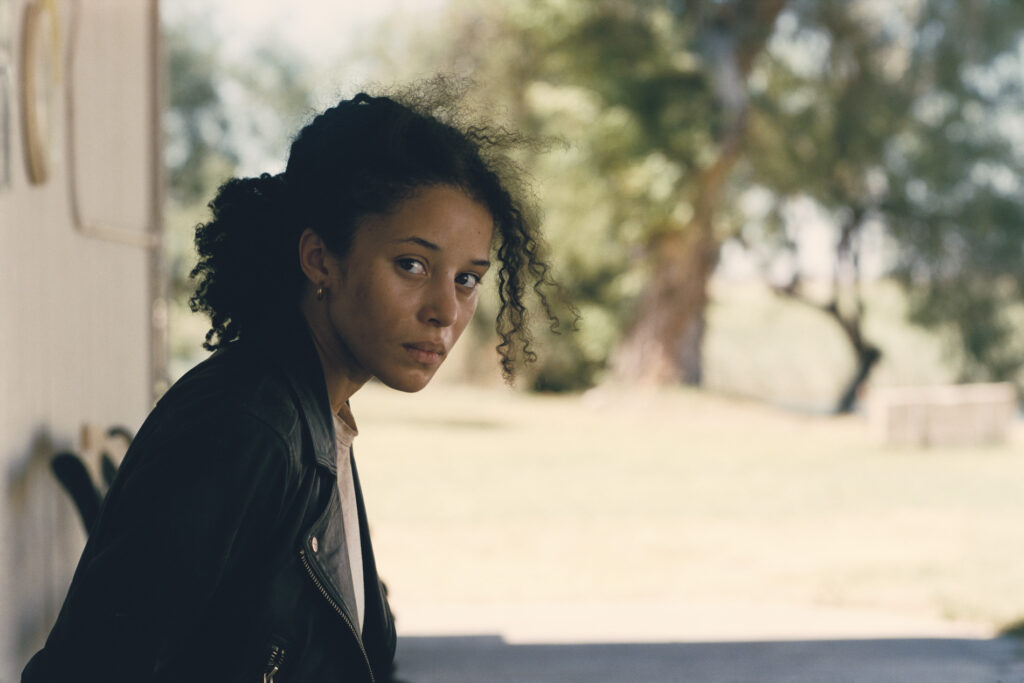
“Watching Paul trust all of us on set and giving me the chance to communicate how I viewed Willa…was really special,” Infiniti added.
When Benicio Del Toro (Sensei Sergio St. Carlos) came in with ideas for the film, ranging from character backstories to worldbuilding, Anderson was all in—which led to some of the film’s most iconic moments. (“Latino Harriet Tubman,” anyone?) “He collaborates, and he creates a great atmosphere to explore your character,” Del Toro told the Playlist. “He really wants to hear what you have to say.”
Anderson also showed his actors he trusted them enough to make their own decisions while the camera was rolling. In a scene where Bob hides out from Lockjaw in Sergio’s apartment, “Leo runs in and goes to sit down; he tries to close the curtains, but they fall down,” Bauman said. “That was never scripted or even intended.” Instead of reshooting, Anderson let the actors roll with the mistake and lean into the moment’s comic elements.
To shoot another scene in which Perfidia makes a drastic decision, Anderson cleared the set of nearly all cast and crew so that Teyona Taylor could comfortably try out different approaches. “They were just going to improv it,” Bauman recalled. “We did maybe eight takes, and every take she would just up it even more and more…. I said to Paul, ‘People will come here for the car chase, but they’ll stay for the postpartum rant.’ ”
This type of trust and collaboration not only makes for a better movie—it can also be extremely fulfilling for filmmakers. Or as Anderson told Rolling Stone: “The thing I cherish the most now and gets me the most excited is the friendship and camaraderie and the collaboration that happens when you do the work.”