“Anora”—Sean Baker’s gritty, subversive, profanity-laden exploration of class, power, and autonomy as seen through the lens of a sex worker—doesn’t exactly sound like your traditional Oscar fare. But when the unconventional film swept the 97th Academy Awards, it was a shared victory for an entire generation of innovative filmmakers.
Here, several such luminaries share their wisdom, explaining that making a transformative film is a matter of laying the groundwork, connecting with actors, engaging in the endless pursuit of truth, and allowing yourself to be driven by pure grit.
Master the art of preparation.
Bob Ross was right—little accidents can, indeed, be happy; but to be cinematically successful, these moments of spontaneous discovery must stem from a foundation of thorough preparation.
For RaMell Ross, the visionary behind the 2024 reform-school drama “Nickel Boys,” preparation begins with full immersion in one’s subject. Knowing that he wanted to shoot the movie primarily using first-person point of view, Ross studied theories of perception, particularly Charles Horton Cooley’s “looking-glass self.” This engendered a deep understanding of how “you come to know yourself through the way that people look at you,” which then “becomes your reality,” he explains. “Nickel Boys” received two Oscar nods, in no small part due to its insightful depiction of the juxtaposition between seeing and being seen.
“We Live in Time” director John Crowley also believes in putting in the work ahead of, well, time. Before filming a pivotal birth sequence in his 2024 romantic drama, he enlisted professional midwife Penny Taylor to guide star Florence Pugh on the birthing process. Production also brought in a real-life newborn for Pugh and her costar Andrew Garfield to hold at the end of the scene. “This little baby shifted the central gravity of the scene and took it to a whole other level of reality,” he says.
Finally, rehearse—but don’t overdo it. “In order to lean into the spontaneous stuff that happens in the magic of filmmaking, you need to have done all the work beforehand,” notes Chloe Domont, the writer-director of 2023’s psychological thriller “Fair Play.”
Megan Park, who created the 2024 coming-of-age comedy “My Old Ass,” shares, “The rehearsal process is usually when I make a lot of the changes; talking about the scenes is when you discover stuff.”
Collaboration is key.
Filmmaking is fundamentally synergistic, so it’s vital that directors create safe spaces in which actors feel free to take creative risks.
“My goal on any project is to learn an actor’s language versus imposition,” says Victoria Mahoney, director of the 2025 fantasy-action flick “The Old Guard 2.” “Ultimately, my job is to make [them] feel safe in order to give their optimal creative self.”
Park leverages her background as a working actor to connect with performers on their level. “The most valuable tool I have as a director is how comfortable I am around actors—figuring out quickly what they need or don’t need from me,” she explains. “I can relate to little things like that more than directors who haven’t been on the other side.”
This approach extends to the entire crew. “I want my sets to feel relaxed; that creates the most collaborative experience,” Park says. “Filmmaking is a team sport—and if you go into it with that intention, you’re already 10 steps ahead of most directors.”
Strive for authenticity.
Your film should tell a story that only you can tell. Consider why you want to make your film: Do you resonate with its characters? Does it provide a unique perspective or excavate a hidden truth? If you can answer a resounding yes—“if your film is authentic and true to who you are, it’s going to be better than most of the stuff out there,” according to Park.
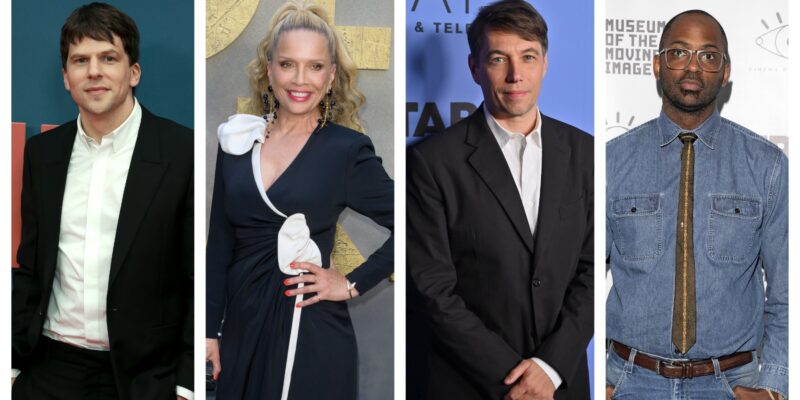
For Jesse Eisenberg, who created and starred in the 2024 comedy-drama “A Real Pain,” this realness comes from a deep sense of connection with characters. “When I’m writing a script, I am every single character,” he says, “because my background is as an actor, where you’re trained to try to understand your character even if they’re the villain.” Eisenberg’s radical empathy with his characters paid off: The film garnered a supporting actor Oscar win for costar Kieran Culkin.
“Anora” writer-director Baker also strives to see the world from his characters’ perspectives, rather than imposing external judgment. “We wanted to, perhaps, see the world through the eyes of the people who live there,” he says.
To check a story’s emotional truth, Domont uses a brutal but effective test, asking, “Does anyone give a flying fuck?” While “telling the story you can’t not tell” is important, she feels it should also “challenge the world we live in on some level” to really make an impact. “There is so much stuff out there these days. We are oversaturated,” she says. “I don’t think it’s enough to just make a good movie anymore. A film has to say something about the state of the world that hasn’t been explored.”
Be persistent.
Perhaps the most crucial advice from these directors is also the simplest: Don’t give up! The key is perseverance combined with self-awareness. Success requires “persistence and obsession,” says Domont; the ability to “go with your gut, and stay open-minded,” advises Park; and the willingness to “embrace the unknown,” explains Mahoney.
As these legends of cinema demonstrate, carving your path forward in the industry means recognizing your perspective, sharing it in a way that feels both real and right, and then having the tenacity to see it through.