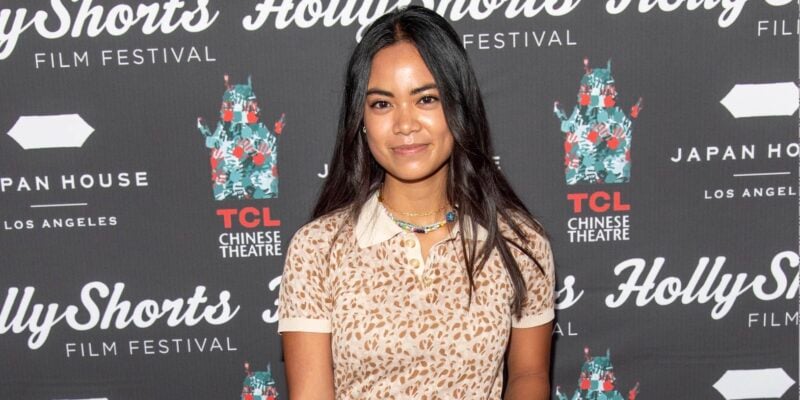
An actor-turned-filmmaker with a passion for food, a staging gig behind a Paris cookie counter, and a Taiwanese-American baker with a delightfully romantic story: Mix them up, add a dash of serendipity, and you get the unlikely (yet delicious) recipe behind “Cookie, Love” (2026). We spoke with documentarian Sari Arambulo about how her nine-minute passion project was whisked away to Tribeca for its world premiere.
You were working in Jean Hwang Carrant’s cookie shop when you decided to film a documentary. Was there a specific moment that crystallized the decision?
It’s funny to think back on that exact moment. I was staging at Jean’s cookie store and completely falling in love with her in the process. She has such an amazing spirit, and I really resonate with her philosophy on cookies—her wabi-sabi approach to her craft. At the same time, I had this long list of creative to-dos, and the last thing on it was to make a short film. I actually thought I’d make a narrative proof of concept for a pilot I’d written, but once I started thinking about preproduction, I realized I didn’t have enough time.
Then it hit me that Jean’s life held all the themes I love to explore. She’s Taiwanese American, living in Paris, making a name for herself with American cookies in the French pastry capital of the world. That whole idea crossed my mind, and I thought, there’s definitely a story here. She’s someone you can’t help but want to be around.
As a Filipina American filmmaker telling the story of a Taiwanese American baker, did you find yourself navigating cultural differences, or were there shared experiences that helped you portray her so intimately?
As a Filipina American, I resonated with her right away. When she told me she was a Taiwanese American woman living in Paris, I just connected with it. I’ve also spent a lot of time in France—I’ve studied the language since I was 16, and I did a foreign exchange program at that age, where I met my French best friend—so I feel this strange kinship with the country. I’ve always admired people who can build a life there and truly thrive in it.
On a darker note, I’ve experienced moments of feeling unseen or misunderstood there, too, and Jean and I could talk about that, but we could also just bond over our love of France. Even down to the words she’d use: She’d say something like, “I’ll recuperate my key,” and because I speak French, I knew she was thinking in French and speaking in English. As a filmmaker, I love to uplift Asian American stories—particularly about women—and Jean encapsulates all of that.
Food is a theme in all your projects. Was that intentional from the start, or did it emerge over time?
It was more over time. As you get older you build a bigger body of work, and I noticed I kept getting drawn to food: food at the intersection of multiculturalism, food as a vehicle for self-expression. I like to use it as a cultural touchstone to talk about larger themes—identity, but also finding a sense of belonging and home.
Whether it’s a pilot or a feature, my work is always about food, but also about finding home, belonging, and ultimately love. Early in my screenwriting journey, someone read a sample of my food feature and said, “It sounds like you like to write about love,” and I thought, whoa, I do. At the time I didn’t see it. Now, looking at my work with a bird’s-eye view, that’s definitely a throughline—and it certainly comes across in “Cookie, Love.”
How did you translate those ideas—home, love, belonging—into the visual language of the film? Did you have specific references?
I really wanted to create different worlds within the documentary. We see Jean in her kitchen, thriving in her element; then, when we turn to love, we’re in her home, opening the letters between her and her French husband.
I’m a foodie, and I’m inspired by food pieces; “Chef’s Table” (2015) was a huge reference. I’ve always loved how that series treats its tabletop setups. I find them elegant, bold, and dynamic, so I wanted to figure out Jean’s take on the tabletop. We built shots with a red felt background—red is her signature color at the store—and you see hands placing photos down, almost like she’s piecing together the bits of her life in real time.
At the same time, I wanted everything composed, leaning into her quirky, bright spirit, so there are Wes Anderson–style wide shots, like Jean picking up eggs and carrying them across the frame. Then, in the kitchen, I wanted to be right there with her, so we went handheld. And I wanted the food to be its own character, so there are slow-motion shots that lean into its beauty.
You come to directing from years in front of the camera. How did your acting background shape the work behind it? Did you have to unlearn anything?
I think actors make great directors, because actors are, in essence, really good at talking to people and deeply empathetic, and that brings out the best in a performance. People kept commenting on how natural Jean was on camera, and she told me, “That’s because you made me feel comfortable, and you knew what I needed.” That’s pretty inherent to an actor. You know what you’d want to receive as on-camera talent.
The unlearning is harder. Directing lets me unleash my creativity in a different way, because it’s complete autonomy. So often as an actor you’re at the beck and call of someone else’s vision, and I’ve always felt I had more to say than the words I was given. As a multihyphenate, filmmaking fuels me in a way that makes acting sustainable; the two feed each other. And directing has informed me as an actor too. You learn there’s only one you. What makes you special is that you’re the only one who can deliver a line a certain way. Leaning into who you are is your secret power.
You largely self-funded the film. What did those financial constraints mean on the ground?
On the financial side, I reconnected with a content creator named Jeremy [Jacobowitz] whom I’d followed for a long time. He’d followed me back—turns out he was a fan of a show I was on—and he mentioned wanting to get more into film. That was the same year I went to Paris and came up with the idea, so I pitched it to him. I’m happy to share the numbers: I asked for $5,000, which was the big chunk of our budget, and he came aboard as our EP.
For the tabletop pickups in Los Angeles, I self-funded a lot of the post-production add-ons. As for other constraints, I’ve never really rented gear; I’m a fairly seasoned producer, but doing this in L.A. or New York is one thing, and doing it in a foreign country is completely different. That’s where I was so grateful for my producer and DP, Anthony [Vazquez], who’s half French, half American. Fun fact: We met on a Bumble date my first week in Paris. We didn’t hit it off that way, but we clicked as collaborators, which is apropos for a film about cookies and love. We shot for two and a half days, so we had to stay nimble.
That’s one of the big lessons of documentary: So much comes through in the edit, and you don’t know exactly what you’ll get on the day. There’s a moment where Jean invites a customer into the back of her kitchen. People tell me it’s their favorite part, and it wasn’t planned at all. You can practically see the camera turning in real time, because it’s me going, “Oh, my god, she just did that—turn, turn, go, go, go.”
Your path to Tribeca was unusual. Can you walk us through it?
It took me a while to finish. I shot at the end of 2023, did pickups in 2024, and finished post in L.A. and then New York, where a lot of the score and composition happened. I technically wrapped in April 2025 but was so busy with another project that I didn’t submit it until November. Honestly, I never really meant for it to go anywhere; I thought of it as a portfolio piece for my food feature, my little passion project. When I looked at where to submit, I really just wanted an Asian American film festival.
The only big one left was Tribeca, so I submitted almost on autopilot, thinking, it’s not going to get in, but you submit because that’s what you do. Then, in February, Jean texted me out of nowhere. Someone had come into the shop and asked, “Are you Jean? I saw the short film.” She said, “Do you know Sari?” and he said, “No, but my name is Ben, and I’m with the Tribeca Festival.” Jean stopped in her tracks and started to cry. She didn’t even know I’d submitted. He bought a bunch of cookies and left a review that was reminiscent of the short. For me, that was already the win. I looked him up afterward: Ben Thompson, Tribeca’s vice president of shorts programming. The fact that someone of his caliber came to the cookie store after watching something I made—that was it. Then, at the end of March, Thompson called to tell me we got in. I screamed and fell to the floor. The wild part was that I was leaving for Paris the next night, so I got to tell Jean in person.
What’s your best advice for aspiring documentarians or filmmakers in general?
You just have to make your art. Try to make as many things as you can. I struggle with this too; I’m a perfectionist, and I always feel like it has to be perfect. [But] I changed my mindset and went for volume instead of perfection. That became my creative mantra. I was inspired by an artist—I think it was Picasso—who made hundreds of pieces across his life. I thought, what if I did that?
When you’re at the start of your career, you’re learning what you like—which styles, which collaborators—and the only way you get better is by making that first thing. It seems scary, but the only way you learn is by doing it. And trust your creative voice. I made “Cookie, Love” simply because I wanted to, and the fact that it’s where it is now is incredible to me. When you’re called to make something, I think it’s your responsibility to do it. So keep making as much as you can, and listen to that inner voice.
“Cookie, Love” had its world premiere at the 2026 Tribeca Festival. Follow Sari Arambulo on Instagram, and learn more about Jean’s Paris shop, Cookie Love. The film’s festival page is here.